Years from now the record books will show the St. Louis Cardinals defeated the Detroit Tigers 4 games to 1 in the 2006 World Series, but for those few souls who actually watched these contests, the closer truth might be that the Detroit Tigers defeated the Detroit Tigers.
To give them their due, the Cardinals’ pitching stifled the previously hot Tiger bats throughout the series, but had Detroit’s own pitching staff fielded and thrown batted balls more cleanly – they made five disastrous errors in the five games – thing might have turned out a whole lot differently. A partisan sign in the stands at Busch Stadium said it all: Hit it to their pitchers.
Thus ends one of the least interesting or dramatic Series in history as the underdog Cardinals triumphed before the smallest television viewing audiences in recorded history. The series did feature the usual quota of unexpected heroes including Cardinal shortstop David Eckstein, who provided more offense than the vaunted Albert Pujols, and St. Louis starter Jeff Weaver, who began his major league career with the Tigers in 1999 and then bounced around to a few other clubs before being traded to the Cards by the Dodgers at mid-season for cash and Terry Evans.
Terry who? Precisely.
Saturday, October 28, 2006


Friday, October 27, 2006
Frozen Ropes & Fungoes
Apart from Dirtgate, the main topic of conversation during this drab and uninspiring World Series has been the weather; so, if you are looking for a classic, keep looking.
The Cardinals took a 3-1 lead over the Tigers last night when wet balls and lousy traction conspired to undue the Tigers. Perhaps the baseball gods really have the Motor City’s residents’ best interests at heart after all. The possibility of their celebrating a World Series triumph and Devil Night at the same time is a frightening prospect, especially to the Detroit fire and police departments.
* * * * * * * *
The inclement weather of the current post season has brought renewed calls for shortening the regular season and altering the playoff format. If it rains or snows two more times during this Series there is a decent chance North American baseball will be played in November for the first time. No one wants that, least of all the players.
I cannot recall any professional sport willingly shortening its season; indeed, all of them look for ways to extend it no matter what the consequences to the games themselves or the athletes. The more likely scenario for MLB will be that some variation on the World Baseball Classic will take root either before or after the season in North America. I doubt anyone would support a WBC interrupting the regular season as hockey has done the past few Olympiads. If the WBC does develop into a regularly scheduled affair, look for more games to be played on other continents, where the weather will be better and the local fans are perhaps more passionate about the sport than their North American counterparts.
* * * * * * * *
Speaking of games being played outside the United States, I’d like to follow up the discussions taking place in this space recently regarding contraction.
MLB will not contract any of its current franchises. Instead, the Commissioner and owners will encourage the Jeffrey Lorias of baseball to attempt to extort a sweetheart deal for a new stadium and, failing that, to move to greener pastures, or, in Loria’s case, browner ones.
Instead of contraction, another possibility already exists. For those franchises with ever-dwindling support and prospects, the Expos’ model may foreshadow things to come. When that franchise was in limbo prior to being awarded to Washington, MLB took over ownership and scheduled some of the team’s home games in Puerto Rico. Given that MLB is on record as desiring more international exposure, there is every reason to believe they will take struggling franchises like the Marlins and schedule them to play a portion of their games in, say, Monterry, Mexico, or Caracas, Venezuela.
With a large number of Latin American players on MLB rosters, the connection and appeal to audiences in their native-born countries has never been stronger. As far as travel arrangements are concerned, flights to any destinations south of the border are no more arduous than transcontinental ones. An ever-increasing number of Asian players on MLB rosters might also increase interest in scheduling games in Korea and Japan, but the travel times would make such games highly unlikely.
As the basketball model clearly demonstrates, the international revolution in professional sports is being consolidated and the United States is clearly no longer dominant. Baseball, third only to soccer and basketball in the number of countries in which it is played, is primed to be the next truly international game.
The Cardinals took a 3-1 lead over the Tigers last night when wet balls and lousy traction conspired to undue the Tigers. Perhaps the baseball gods really have the Motor City’s residents’ best interests at heart after all. The possibility of their celebrating a World Series triumph and Devil Night at the same time is a frightening prospect, especially to the Detroit fire and police departments.
* * * * * * * *
The inclement weather of the current post season has brought renewed calls for shortening the regular season and altering the playoff format. If it rains or snows two more times during this Series there is a decent chance North American baseball will be played in November for the first time. No one wants that, least of all the players.
I cannot recall any professional sport willingly shortening its season; indeed, all of them look for ways to extend it no matter what the consequences to the games themselves or the athletes. The more likely scenario for MLB will be that some variation on the World Baseball Classic will take root either before or after the season in North America. I doubt anyone would support a WBC interrupting the regular season as hockey has done the past few Olympiads. If the WBC does develop into a regularly scheduled affair, look for more games to be played on other continents, where the weather will be better and the local fans are perhaps more passionate about the sport than their North American counterparts.
* * * * * * * *
Speaking of games being played outside the United States, I’d like to follow up the discussions taking place in this space recently regarding contraction.
MLB will not contract any of its current franchises. Instead, the Commissioner and owners will encourage the Jeffrey Lorias of baseball to attempt to extort a sweetheart deal for a new stadium and, failing that, to move to greener pastures, or, in Loria’s case, browner ones.
Instead of contraction, another possibility already exists. For those franchises with ever-dwindling support and prospects, the Expos’ model may foreshadow things to come. When that franchise was in limbo prior to being awarded to Washington, MLB took over ownership and scheduled some of the team’s home games in Puerto Rico. Given that MLB is on record as desiring more international exposure, there is every reason to believe they will take struggling franchises like the Marlins and schedule them to play a portion of their games in, say, Monterry, Mexico, or Caracas, Venezuela.
With a large number of Latin American players on MLB rosters, the connection and appeal to audiences in their native-born countries has never been stronger. As far as travel arrangements are concerned, flights to any destinations south of the border are no more arduous than transcontinental ones. An ever-increasing number of Asian players on MLB rosters might also increase interest in scheduling games in Korea and Japan, but the travel times would make such games highly unlikely.
As the basketball model clearly demonstrates, the international revolution in professional sports is being consolidated and the United States is clearly no longer dominant. Baseball, third only to soccer and basketball in the number of countries in which it is played, is primed to be the next truly international game.
Thursday, October 26, 2006
Thoughts on Contraction By George S.
Commenter extraordinaire far eastern division George S. sent several of the bloggers an email last week outlining his thoughts on contraction. With his permission, I present it here. (Note: Because of Blogger's formatting restraints, I was forced to list his proposed alignments vertically, which is less than ideal.)
I’ve seen several comments recently, and have seen and heard them in past seasons, regarding how bad it is for MLB when two of their ‘lesser lights’ franchises manage to go far into the postseason. These smaller market teams generate little national interest and television ratings drop like a stone. These comments come from MLB owners and MLB officials, as well as the broadcast networks, usually shielded by using the print media as the messenger.
For their own part, in these situations the media interest is more focused on the novelty of seeing these teams in big games rather than repecting them as valid champions. What then are fans to think of those teams?
Now from a business standpoint, from the standpoint of making money, these complaints are certainly understandable. It’s the same reason movie studios pay big money for the superstars. After all, they could get any actor if they wanted, but people will watch the megastars even in a clunker.
So what to do?
Well one thing MLB could do would be to bring the ‘lesser lights’ teams up to a more equitable level with the big guys. This would not only require some sort of salary cap/competitive balance idea, but also that MLB spend their promotional money to put more focus on the smaller market teams. MLB doing any of these things is highly unlikely. And it is highly questionable that it would work anyway.
Baseball is a very traditional sport. The pace of the game itself is reflected in it’s cultivation of it’s fans. I believe it takes generations for teams to develop identities and to build a loyal fan base. Even with changes in ownership and venue, these traditional identities are hard to change.
For that reason the older franchises will almost always attract more attention nationally than newer ones. In fact, they attract more fans nationally even when they are a losing team than many newer franchises do that are winners. More people around the country will admit to being an Indians, Cubs, Pirates or even Phillies fan than a Diamondbacks or Marlins fan. So naturally enough when these ‘newer’ franchises reach the WS, regardless of their geographic locale, there is less national interest.
Of all the expansion teams, I think Houston, after 45 years (two generations) is the closest to having built any loyal fan base outside of their local area. The Expos, Padres, Brewers, even Blue Jays, Twins and Mariners? Not even close.
There is also the plain truth that some franchises are located in cities that simply are not ‘baseball towns’. Is Denver a baseball town? Was Montreal? Sure, they had nice AAA teams, but those were linked to other MLB teams. Is Tampa Bay?
More importantly, will they ever become baseball towns? I think not. There is nothing un-American about it. Baseball is just not something easily embraced in those locations. Seattle? (Maybe more so now with the influx of Asian-Americans).
So I think it is time for MLB to seriously consider contraction. This solves several problems.
How many teams should there be? From the current 30 teams I would suggest that baseball reduce to 24 teams, 12 in each league, 6 each in an Eastern and Western Division. The 4 division champions play for the championship.
How do you select the 6 teams to be eliminated? There are several ways, based on demographics, for example, or evaluation of ownership, or by the performance over time of the franchise. But I think that no matter what method they finally devise, it must be based on looking at baseball nationally, not locally. No matter how faithful a following a team might have locally, if that team does not benefit baseball overall, they should be considered to be contracted.
If I was to choose today, I would choose 6 from the following 10 teams:
Washington Tampa Bay
Florida Minnesota
Milwaukee Kansas City
Pittsburgh Arizona
Colorado Toronto
Of those, my current vote would be to keep Pittsburgh, KC, Toronto and Minnesota. But let’s look at two scenarios, conservative and radical.
First, if you wanted to maintain AL-NL integrity, you would want each at 12 teams, so to avoid having a team switch leagues, you would contract Tampa Bay and Kansas City from the AL, and Washington, Florida, Colorado and Milwaukee from the NL. The divisions would then look like this:
AL East
New York
Boston
Baltimore
Cleveland
Detroit
Toronto
Al West
LA
Texas
Oakland
Seattle
Chicago WS
Minn
NL East
NY
Phila
Pitt
Chicago
Cinn
Atlanta
NL West
LA
SF
SD
Houston
STL
Arizona
If you wanted a more radical re-alignment, you would keep Kansas City and contract Arizona, leaving you with this, which is much more travel friendly, but involves much more switching of leagues:
East
Chicago WS
Chicago
Cleveland
Detroit SF
Toronto
Cincinnati
West
Atlanta
Houston
Texas
ST L
Minn
KC
East
Baltimore
Boston
Phila
NYY
NYM
Pitt
West
LAD
LLA
SF
SD
Oakland
Seattle
You can choose which belong to the AL and which belong to the NL, or actually scrap the idea of AL and NL altogether, simply having Eastern champs playoff for a WS slot, and Western champs do the same. This would also require standardization of baseball rules, such as use of the DH.
Current ‘lesser lights’ like KC, Pittsburgh, Oakland and Minnesota should be helped by this re-alignment, which brings in more revenue and cuts travel. It also promotes the so-called local rivalries that are now used as the excuse for interleague play.
In the longterm, contraction would better support the health and prosperity of baseball in the United States. With cable and internet today, it is no longer necessary to have MLB physically present in every corner of the country. In fact, nothing says that some series could not be played at ‘neutral’ sites each season. For example, each team might play 6 games total each year at non-MLB cities, such as Denver, Milwaukee, Miami, etc. If there were 8 such cities, they would each get 3 series a year, featuring 2 different teams each series. If properly promoted by MLB, these neutral site games would keep MLB visible throughout the country during the season.
Of course, the MLBPA would fight all contraction tooth and nail, since 20% of player jobs would be gone. But a more enlightened leadership than Donald Fehr might be able to look at the bigger picture and see that baseball as it is now structured doesn’t work longterm. There is little interest from native-born athletes to go into baseball. The fan base is older. The game itself is being constantly tinkered with to keep interest up. The season is too long and there are too many bad teams.
The 20% loss of jobs would be better made up in the next expansion, which I would advocate be an international expansion. This might entail a league in Latin America and one in Asia, comprised of existing franchises in those regions or of new franchises set up in partnership between MLB and local owners. These international leagues would not play against the US teams except in a true WS, which would eventually take place.
In this way baseball in the US might be revived and interest maintained througout the regular and postseason.
I’ve seen several comments recently, and have seen and heard them in past seasons, regarding how bad it is for MLB when two of their ‘lesser lights’ franchises manage to go far into the postseason. These smaller market teams generate little national interest and television ratings drop like a stone. These comments come from MLB owners and MLB officials, as well as the broadcast networks, usually shielded by using the print media as the messenger.
For their own part, in these situations the media interest is more focused on the novelty of seeing these teams in big games rather than repecting them as valid champions. What then are fans to think of those teams?
Now from a business standpoint, from the standpoint of making money, these complaints are certainly understandable. It’s the same reason movie studios pay big money for the superstars. After all, they could get any actor if they wanted, but people will watch the megastars even in a clunker.
So what to do?
Well one thing MLB could do would be to bring the ‘lesser lights’ teams up to a more equitable level with the big guys. This would not only require some sort of salary cap/competitive balance idea, but also that MLB spend their promotional money to put more focus on the smaller market teams. MLB doing any of these things is highly unlikely. And it is highly questionable that it would work anyway.
Baseball is a very traditional sport. The pace of the game itself is reflected in it’s cultivation of it’s fans. I believe it takes generations for teams to develop identities and to build a loyal fan base. Even with changes in ownership and venue, these traditional identities are hard to change.
For that reason the older franchises will almost always attract more attention nationally than newer ones. In fact, they attract more fans nationally even when they are a losing team than many newer franchises do that are winners. More people around the country will admit to being an Indians, Cubs, Pirates or even Phillies fan than a Diamondbacks or Marlins fan. So naturally enough when these ‘newer’ franchises reach the WS, regardless of their geographic locale, there is less national interest.
Of all the expansion teams, I think Houston, after 45 years (two generations) is the closest to having built any loyal fan base outside of their local area. The Expos, Padres, Brewers, even Blue Jays, Twins and Mariners? Not even close.
There is also the plain truth that some franchises are located in cities that simply are not ‘baseball towns’. Is Denver a baseball town? Was Montreal? Sure, they had nice AAA teams, but those were linked to other MLB teams. Is Tampa Bay?
More importantly, will they ever become baseball towns? I think not. There is nothing un-American about it. Baseball is just not something easily embraced in those locations. Seattle? (Maybe more so now with the influx of Asian-Americans).
So I think it is time for MLB to seriously consider contraction. This solves several problems.
- It eliminates teams that cannot or will not compete. It is ridiculous to punish successful teams by making them support the bad ones. You are in a sense asking the Yankees to pay money so they will at least have somebody to play against.
- It can allow for the season to be shortened. First, by reducing the number of playoff teams, and secondly by perhaps reducing the number of games back to 154.
- It allows for better competition and a higher talent level, currently watered-down to embarassing levels by constant expansion. With fewer teams, the caliber of play would certainly improve.
- It better ensures that good teams make the post-season, and that there will be a national interest in the championship no matter who is in it.
How many teams should there be? From the current 30 teams I would suggest that baseball reduce to 24 teams, 12 in each league, 6 each in an Eastern and Western Division. The 4 division champions play for the championship.
How do you select the 6 teams to be eliminated? There are several ways, based on demographics, for example, or evaluation of ownership, or by the performance over time of the franchise. But I think that no matter what method they finally devise, it must be based on looking at baseball nationally, not locally. No matter how faithful a following a team might have locally, if that team does not benefit baseball overall, they should be considered to be contracted.
If I was to choose today, I would choose 6 from the following 10 teams:
Washington Tampa Bay
Florida Minnesota
Milwaukee Kansas City
Pittsburgh Arizona
Colorado Toronto
Of those, my current vote would be to keep Pittsburgh, KC, Toronto and Minnesota. But let’s look at two scenarios, conservative and radical.
First, if you wanted to maintain AL-NL integrity, you would want each at 12 teams, so to avoid having a team switch leagues, you would contract Tampa Bay and Kansas City from the AL, and Washington, Florida, Colorado and Milwaukee from the NL. The divisions would then look like this:
AL East
New York
Boston
Baltimore
Cleveland
Detroit
Toronto
Al West
LA
Texas
Oakland
Seattle
Chicago WS
Minn
NL East
NY
Phila
Pitt
Chicago
Cinn
Atlanta
NL West
LA
SF
SD
Houston
STL
Arizona
If you wanted a more radical re-alignment, you would keep Kansas City and contract Arizona, leaving you with this, which is much more travel friendly, but involves much more switching of leagues:
East
Chicago WS
Chicago
Cleveland
Detroit SF
Toronto
Cincinnati
West
Atlanta
Houston
Texas
ST L
Minn
KC
East
Baltimore
Boston
Phila
NYY
NYM
Pitt
West
LAD
LLA
SF
SD
Oakland
Seattle
You can choose which belong to the AL and which belong to the NL, or actually scrap the idea of AL and NL altogether, simply having Eastern champs playoff for a WS slot, and Western champs do the same. This would also require standardization of baseball rules, such as use of the DH.
Current ‘lesser lights’ like KC, Pittsburgh, Oakland and Minnesota should be helped by this re-alignment, which brings in more revenue and cuts travel. It also promotes the so-called local rivalries that are now used as the excuse for interleague play.
In the longterm, contraction would better support the health and prosperity of baseball in the United States. With cable and internet today, it is no longer necessary to have MLB physically present in every corner of the country. In fact, nothing says that some series could not be played at ‘neutral’ sites each season. For example, each team might play 6 games total each year at non-MLB cities, such as Denver, Milwaukee, Miami, etc. If there were 8 such cities, they would each get 3 series a year, featuring 2 different teams each series. If properly promoted by MLB, these neutral site games would keep MLB visible throughout the country during the season.
Of course, the MLBPA would fight all contraction tooth and nail, since 20% of player jobs would be gone. But a more enlightened leadership than Donald Fehr might be able to look at the bigger picture and see that baseball as it is now structured doesn’t work longterm. There is little interest from native-born athletes to go into baseball. The fan base is older. The game itself is being constantly tinkered with to keep interest up. The season is too long and there are too many bad teams.
The 20% loss of jobs would be better made up in the next expansion, which I would advocate be an international expansion. This might entail a league in Latin America and one in Asia, comprised of existing franchises in those regions or of new franchises set up in partnership between MLB and local owners. These international leagues would not play against the US teams except in a true WS, which would eventually take place.
In this way baseball in the US might be revived and interest maintained througout the regular and postseason.
Wednesday, October 25, 2006
We're Number Three!!
Philadelphia was recently voted the third worst sports town in America. The rankings were the “work” of an online gambling web site who won’t be the beneficiary of a citation let alone link in this space, but you can make book elsewhere we are justified in considering the source. Among the factors used in determining the rankings were the decidedly quantifiable number of championships won by professional sports franchises in a given city and, you guessed it, the exceedingly subjective rating of the behavior of local fans. In the latter case, the people behind this particular list noted that Philadelphia fans were “alcoholic rageaholics”, an affliction that should send substance abuse therapists and local barkeeps to their dictionaries (OK, not the barkeeps) to bone up.
Some myths die hard and the legendary rowdy behavior of the local sports fan is one of them. I will resist beating that dead horse again.
On the other hand, the lack of championship trophies and parades on Broad Street are a matter of public record. Regrettably, it doesn’t appear the totals will increase in the near future.
The Eagles, so close a mere year and a half ago, are now a mediocre team as their 4-3 record attests. Their weaknesses are numerous on both sides of the ball and, more critically, on the sidelines themselves. Coach Andy Reid, a good judge of talent before the games begin, is a rotten administrator when it comes to play-calling and time management. It isn’t as though the final minutes of either half sneak up on Andy; he just doesn’t seem to know what to do when they arrive. Presumably, he runs his charges through two minute drills; the question is, who runs Andy through his? Maybe he should take a cue from the Phillies and hire more ex-head coaches for his staff. Suffice it to say the love affair with Andy is all but over in this town. You know that to be the case when the press, bloggers, cab drivers and hotel doormen all mimic his “This one’s on me” post-game mea-culpas.
Meanwhile, across the street things are even worse if that can be imagined.
The Flyers may be the only organization since the Arizona Diamondbacks hired and fired Wally Bachman within forty-eight hours to give a three-year contract extension to their coach only to fire him a few weeks later. I guess owner Ed Snider knows he is on the hook for that one.
Snider wasn’t done with that dismissal, however. The bigger one was his acceptance of GM Bob Clarke’s “resignation” a face-saving affair for both parties. Clarke admitted to being burned out, but the sad truth is that he just couldn’t adjust to the changes taking place in hockey. A lot of folks believe Clarkie couldn’t let go of the bruiser mentality that marked the Flyers when he was a player, and that was his undoing. Unlike his counterpart across the street, however, Clarke was not a particularly astute judge of talent, especially if that talent was born in Eastern Europe or the former Soviet Union. That change in hockey has been going on for a long time, but Clarke was slow to catch on and would probably still like to stick to drafting and acquiring only players with Canadian or US passports.
Clark also had a penchant for acquiring players who had great records against the Flyers, a factor that should have weighed lightly in trying to build a winner. Clarke was also known to trade away players, regret the decision, and try and reacquire them (which he did more a few times if memory serves). That kind of second-guessing has no place at the top of an organization.
Snider could never forget the young Bobby Clarke, who helped bring the neophyte owner of a then-new franchise not one but two championships and parades in successive years in the mid ‘70’s. (Without those titles Philadelphia might have been number one in the poll under consideration.) That debt had been paid many times over by the time the account was finally closed last week.
The prospects for the other occupants of the Wachovia Center are equally dim as the Sixers prepare for another season under another local hero, Mo Cheeks. Poor Mo. He means well and is probably a competent coach, but it is hard to tell when he simply doesn’t have the talent to work with. Not only is he saddled with an aging veteran forward with lousy knees and a crappy attitude in general, he had to stand by all summer and endure rumors that his other marquee player and the face of the franchise for what seems to be forever, was going to be traded at any minute. Did the Sixers try to trade Allen Iverson and find no takers or did they simply believe no one was willing to offer enough in return? The guess here is that they realized for better or for worse that Iverson was the only draw this team still possessed. Did the Sixers believe fans would turn out to see Samuel Dalembert lope up and down the court or the aforementioned veteran with lousy knees show up for fan appreciation night in civvies?
The other burden Cheeks must carry, though no one would necessarily put it this way, is his General Manager, Billy King. For my money King holds the distinction among GM’s in this town of being the worst judge of talent and least capable horse trader of them all. Even had Ed Wade remained in town, King would hold that distinction, no mean feat.
Finally, of course, we have the Phillies. Brace yourselves, sports fans, because the Phillies may just be the best hope to break the long string of local failures. I am not predicting they will win it all next season, but with a few crucial pickups they should finally make it into the post-season, an achievement that only an online betting site would fail to count as a major triumph!
Some myths die hard and the legendary rowdy behavior of the local sports fan is one of them. I will resist beating that dead horse again.
On the other hand, the lack of championship trophies and parades on Broad Street are a matter of public record. Regrettably, it doesn’t appear the totals will increase in the near future.
The Eagles, so close a mere year and a half ago, are now a mediocre team as their 4-3 record attests. Their weaknesses are numerous on both sides of the ball and, more critically, on the sidelines themselves. Coach Andy Reid, a good judge of talent before the games begin, is a rotten administrator when it comes to play-calling and time management. It isn’t as though the final minutes of either half sneak up on Andy; he just doesn’t seem to know what to do when they arrive. Presumably, he runs his charges through two minute drills; the question is, who runs Andy through his? Maybe he should take a cue from the Phillies and hire more ex-head coaches for his staff. Suffice it to say the love affair with Andy is all but over in this town. You know that to be the case when the press, bloggers, cab drivers and hotel doormen all mimic his “This one’s on me” post-game mea-culpas.
Meanwhile, across the street things are even worse if that can be imagined.
The Flyers may be the only organization since the Arizona Diamondbacks hired and fired Wally Bachman within forty-eight hours to give a three-year contract extension to their coach only to fire him a few weeks later. I guess owner Ed Snider knows he is on the hook for that one.
Snider wasn’t done with that dismissal, however. The bigger one was his acceptance of GM Bob Clarke’s “resignation” a face-saving affair for both parties. Clarke admitted to being burned out, but the sad truth is that he just couldn’t adjust to the changes taking place in hockey. A lot of folks believe Clarkie couldn’t let go of the bruiser mentality that marked the Flyers when he was a player, and that was his undoing. Unlike his counterpart across the street, however, Clarke was not a particularly astute judge of talent, especially if that talent was born in Eastern Europe or the former Soviet Union. That change in hockey has been going on for a long time, but Clarke was slow to catch on and would probably still like to stick to drafting and acquiring only players with Canadian or US passports.
Clark also had a penchant for acquiring players who had great records against the Flyers, a factor that should have weighed lightly in trying to build a winner. Clarke was also known to trade away players, regret the decision, and try and reacquire them (which he did more a few times if memory serves). That kind of second-guessing has no place at the top of an organization.
Snider could never forget the young Bobby Clarke, who helped bring the neophyte owner of a then-new franchise not one but two championships and parades in successive years in the mid ‘70’s. (Without those titles Philadelphia might have been number one in the poll under consideration.) That debt had been paid many times over by the time the account was finally closed last week.
The prospects for the other occupants of the Wachovia Center are equally dim as the Sixers prepare for another season under another local hero, Mo Cheeks. Poor Mo. He means well and is probably a competent coach, but it is hard to tell when he simply doesn’t have the talent to work with. Not only is he saddled with an aging veteran forward with lousy knees and a crappy attitude in general, he had to stand by all summer and endure rumors that his other marquee player and the face of the franchise for what seems to be forever, was going to be traded at any minute. Did the Sixers try to trade Allen Iverson and find no takers or did they simply believe no one was willing to offer enough in return? The guess here is that they realized for better or for worse that Iverson was the only draw this team still possessed. Did the Sixers believe fans would turn out to see Samuel Dalembert lope up and down the court or the aforementioned veteran with lousy knees show up for fan appreciation night in civvies?
The other burden Cheeks must carry, though no one would necessarily put it this way, is his General Manager, Billy King. For my money King holds the distinction among GM’s in this town of being the worst judge of talent and least capable horse trader of them all. Even had Ed Wade remained in town, King would hold that distinction, no mean feat.
Finally, of course, we have the Phillies. Brace yourselves, sports fans, because the Phillies may just be the best hope to break the long string of local failures. I am not predicting they will win it all next season, but with a few crucial pickups they should finally make it into the post-season, an achievement that only an online betting site would fail to count as a major triumph!
Tuesday, October 24, 2006
How Deep Are Your Roots?
Major League Baseball and the Players Association have signed a new five year deal that, if nothing else, is noteworthy for the reportedly peaceful atmosphere in which it was negotiated and concluded. Everybody’s happy! No work stoppages. No rancor. No eleventh-hour brinksmanship.
On the other hand, no tackling of the other big issues facing baseball such as a salary cap or some variation, ongoing drug issues, the length of the season, the playoffs structure, The WBC or struggling franchises. This last matter is a particularly thorny issue when one hears claims regarding how flush all the teams in baseball are – big and small market – due to revenue sharing, luxury taxes, television contracts, and merchandizing revenues.
Overall, major league baseball set an attendance record this past season with over 76 million fans passing through the turnstiles. Beginning with the Commissioner, everyone is congratulating themselves on the health and prosperity of the game.
Listen to Detroit left fielder Craig Monroe on the subject: “Baseball is at an all-time high point right now. You've got low-market teams doing well and different teams winning every year. Getting this done couldn't have come at a better time."
I don’t know if I would agree with the assessment that “low-market teams [are] doing well”. Watching three or four thousand people rattle around in Dolphins Stadium on many nights is not my idea of doing well and I seriously doubt the Marlins’ players enjoy that atmosphere much. People aren’t exactly beating down the doors in Tampa Bay, Kansas City, Colorado, Pittsburgh or Oakland either. Attendance also fell dramatically in Baltimore and Washington last year. Losing will do that, but how do you explain the empty seats for the A’s, who have been consistent winners over the years? Speaking of turnout by the Bays, the Tampa version saw a very modest rise in attendance as some exciting young players began to reach the majors. Despite it all, however, that franchise remains a perennial loser mired in mediocrity. Colorado also fielded a young, competitive team this season but saw only a modest increase in attendance.
Washington was never a great baseball town and for all those fans who claimed to be starved for big league ball, an awful lot of them deserted the team rather quickly or found some other summer entertainment to satisfy their appetites. They can’t use losing as an excuse in the Nation’s capital; not only have they rarely known winning in their first and second incarnations (“First in peace; first in war….”) , but the Expos hardly had much of a winning tradition in their final seasons in Canada. Washington knew what it was getting. Some will blame the decline on the Nationals’ admittedly tired old excuse for a baseball stadium, but if you enjoy baseball and have missed having your own team for more than 30 years, a tired old stadium seems like a small price to pay. As I wrote when the franchise was awarded to Washington in the first place, they should have moved the Expos to Rehoboth Beach, DE, because that’s still where most of the people with money in DC can be found all summer anyway.
Some cities with relatively new stadiums have seen a one-season bounce in attendance at most. Even in relatively healthy Philadelphia, the team saw a drop of 600,000 people in 2005 following the opening of Citizens Bank Park the year before. The Phillies spent much of that second season wallowing in self-destruction only to resurrect themselves in August and September, too late by one game to make the playoffs. Attendance increased last season, but did not reach the level of that inaugural season despite another dramatic late season surge by the Phils and the presence of national sensation Ryan Howard. Prior to moving into their new home, the Phillies were a mediocre team playing in an awful stadium and attendance suffered. New digs will certainly bring ‘em in…but how long will them come simply if you build a new home? Pittsburgh hasn’t been very competitive on the field for quite some time now and while the consensus is they play in one of the most appealing venues in all of baseball, people are not showing up just for the surroundings.
Baltimore saw a mini rebellion of its long-suffering fans as roughly 1000 of them staged a mid-game walk-out towards the end of the season to protest the ownership of Peter Angelos. Some argued it was a publicity stunt by the ring leader, who had some commercial interest that allegedly would benefit from the press coverage, but the Orioles also drew 500,000 less people in 2006 than in 2005. Those other 499,999 people had nothing to gain by staying away except, perhaps, their sanity. Camden Yards has long been regarded as the granddaddy of retro stadiums and a great place to watch a ball game, but losing year after year is finally taking its toll. A new franchise 35 miles south certainly hasn’t helped matters.
Putting a winning team on the field normally improves attendance markedly. Detroit saw an increase of more than half a million at the gate during their resurgence in 2006. Still, there are a number of franchises that remain perennially stuck near the bottom of the pack in the standings and at the gate and despite revenue sharing, luxury taxes and other lucrative contracts, they cannot get over that hump. The explanations are complex and varied. Winning is the biggest key to success, but that success can be quite elusive if the team has an incompetent or worse ownership, free agents are unwilling to play in their climate or stadium, or if players perceive a clear lack of probability of making it to the post-season with a particular team’s current roster.
Some of these towns are simply not baseball towns. The cities that have successfully navigated the shoals of feast and famine generally have a rich tradition of baseball on which to draw when times are lean. The fans in Pittsburgh will be back when the team is competitive again. So, too, will the Orioles’ faithful.
On the other hand, Florida and Arizona, whose shrewd management managed to acquire free agents who put them over the top and who just as quickly rid themselves of these same players shortly thereafter, will never be good baseball towns. The Marlins’ owners were never really interested in building a baseball tradition in the first place; for the Wayne Huizinga’s of the world it was all about quick turnover of the franchise itself. No one is suggesting these guys operate at a loss (though overall franchise resale value and not year-to-year profitability is what matters to owners) but if a team wants fan loyalty it might help to show some of its own. Florida’s current ownership is at it again, trying to extort a new stadium from the local citizenry when what it really wants is to move to Las Vegas. Arizona’s attendance has declined by roughly a million, or one third, since it won the World Series. Big signings there preceded the championship season; big divestitures and near bankruptcy followed it. New owners took over a mere seven years after the team played its first game amidst all sorts of accusations regarding over $150 million of deferred compensation packages for players.
Why aren’t Denver, Miami and Phoenix good baseball towns? Part of the reason is they don’t have several generations who grew up fans of the game. There are no grandfathers and fathers passing down the lore and tradition of watching, say, the Diamondbacks. Heck, most of the current generation living in these towns just arrived there themselves within the last few years. Phoenix is just one huge refugee camp with “snowbirds” from the Northeast and Midwest swelling the ranks permanently rather than just for a visit.
Baseball fans in cities like New York, Boston and Philadelphia have generations of loyalty to draw on. Take the Phillies. It’s interesting to note that several commenters on this blog and others reside in far-off places like Portland, Oregon, or Ho Chi Minh City, Vietnam. No matter where they live, they remain connected to the home team as they understand the term “home”. Despite such distant locales, these fans grew up sitting by their fathers and grandfathers who were also Phillies fans. Baseball’s greatest advantage lies in its roots deep within our personal histories. The longer that history, the deeper the roots. Even when times are bad, the roots are there to sustain the franchise through thick and thin. On the other hand, no matter how retro the stadium and no matter how many pools, saunas and other diversions are part of the package, teams in places like Denver and Miami have no such tradition to draw on. They might see a jump in attendance and interest when the team does well, but there’s little that can sustain interest through the lean times…except football. Ask someone in Denver to choose between the Rockies and Broncos and you are likely to receive one long incredulous stare.
If the Rockies were to pull the stunt Robert Irsay pulled in Baltimore many years ago when he packed up the Colts and sneaked out of town under cover of darkness, there would be a few protests at first light and the city fathers would cry foul, but the good folks in Denver would soon get over their loss. Compare that to the people in New York who still lament the departure of the Dodgers and Giants. Admittedly, theirs is a dwindling number, but those of us in cities like Philadelphia can relate to their sense of undying loyalty and loss. After all, when a grandfather can tell his son he saw Babe Ruth play and his son in turn can say he saw Joe DiMaggio at the end of his career and Mickey Mantle at the beginning of his and his son grew up watching Derek Jeter, that is a long line that cannot be easily broken by a few down seasons or changes of address.
On the other hand, no tackling of the other big issues facing baseball such as a salary cap or some variation, ongoing drug issues, the length of the season, the playoffs structure, The WBC or struggling franchises. This last matter is a particularly thorny issue when one hears claims regarding how flush all the teams in baseball are – big and small market – due to revenue sharing, luxury taxes, television contracts, and merchandizing revenues.
Overall, major league baseball set an attendance record this past season with over 76 million fans passing through the turnstiles. Beginning with the Commissioner, everyone is congratulating themselves on the health and prosperity of the game.
Listen to Detroit left fielder Craig Monroe on the subject: “Baseball is at an all-time high point right now. You've got low-market teams doing well and different teams winning every year. Getting this done couldn't have come at a better time."
I don’t know if I would agree with the assessment that “low-market teams [are] doing well”. Watching three or four thousand people rattle around in Dolphins Stadium on many nights is not my idea of doing well and I seriously doubt the Marlins’ players enjoy that atmosphere much. People aren’t exactly beating down the doors in Tampa Bay, Kansas City, Colorado, Pittsburgh or Oakland either. Attendance also fell dramatically in Baltimore and Washington last year. Losing will do that, but how do you explain the empty seats for the A’s, who have been consistent winners over the years? Speaking of turnout by the Bays, the Tampa version saw a very modest rise in attendance as some exciting young players began to reach the majors. Despite it all, however, that franchise remains a perennial loser mired in mediocrity. Colorado also fielded a young, competitive team this season but saw only a modest increase in attendance.
Washington was never a great baseball town and for all those fans who claimed to be starved for big league ball, an awful lot of them deserted the team rather quickly or found some other summer entertainment to satisfy their appetites. They can’t use losing as an excuse in the Nation’s capital; not only have they rarely known winning in their first and second incarnations (“First in peace; first in war….”) , but the Expos hardly had much of a winning tradition in their final seasons in Canada. Washington knew what it was getting. Some will blame the decline on the Nationals’ admittedly tired old excuse for a baseball stadium, but if you enjoy baseball and have missed having your own team for more than 30 years, a tired old stadium seems like a small price to pay. As I wrote when the franchise was awarded to Washington in the first place, they should have moved the Expos to Rehoboth Beach, DE, because that’s still where most of the people with money in DC can be found all summer anyway.
Some cities with relatively new stadiums have seen a one-season bounce in attendance at most. Even in relatively healthy Philadelphia, the team saw a drop of 600,000 people in 2005 following the opening of Citizens Bank Park the year before. The Phillies spent much of that second season wallowing in self-destruction only to resurrect themselves in August and September, too late by one game to make the playoffs. Attendance increased last season, but did not reach the level of that inaugural season despite another dramatic late season surge by the Phils and the presence of national sensation Ryan Howard. Prior to moving into their new home, the Phillies were a mediocre team playing in an awful stadium and attendance suffered. New digs will certainly bring ‘em in…but how long will them come simply if you build a new home? Pittsburgh hasn’t been very competitive on the field for quite some time now and while the consensus is they play in one of the most appealing venues in all of baseball, people are not showing up just for the surroundings.
Baltimore saw a mini rebellion of its long-suffering fans as roughly 1000 of them staged a mid-game walk-out towards the end of the season to protest the ownership of Peter Angelos. Some argued it was a publicity stunt by the ring leader, who had some commercial interest that allegedly would benefit from the press coverage, but the Orioles also drew 500,000 less people in 2006 than in 2005. Those other 499,999 people had nothing to gain by staying away except, perhaps, their sanity. Camden Yards has long been regarded as the granddaddy of retro stadiums and a great place to watch a ball game, but losing year after year is finally taking its toll. A new franchise 35 miles south certainly hasn’t helped matters.
Putting a winning team on the field normally improves attendance markedly. Detroit saw an increase of more than half a million at the gate during their resurgence in 2006. Still, there are a number of franchises that remain perennially stuck near the bottom of the pack in the standings and at the gate and despite revenue sharing, luxury taxes and other lucrative contracts, they cannot get over that hump. The explanations are complex and varied. Winning is the biggest key to success, but that success can be quite elusive if the team has an incompetent or worse ownership, free agents are unwilling to play in their climate or stadium, or if players perceive a clear lack of probability of making it to the post-season with a particular team’s current roster.
Some of these towns are simply not baseball towns. The cities that have successfully navigated the shoals of feast and famine generally have a rich tradition of baseball on which to draw when times are lean. The fans in Pittsburgh will be back when the team is competitive again. So, too, will the Orioles’ faithful.
On the other hand, Florida and Arizona, whose shrewd management managed to acquire free agents who put them over the top and who just as quickly rid themselves of these same players shortly thereafter, will never be good baseball towns. The Marlins’ owners were never really interested in building a baseball tradition in the first place; for the Wayne Huizinga’s of the world it was all about quick turnover of the franchise itself. No one is suggesting these guys operate at a loss (though overall franchise resale value and not year-to-year profitability is what matters to owners) but if a team wants fan loyalty it might help to show some of its own. Florida’s current ownership is at it again, trying to extort a new stadium from the local citizenry when what it really wants is to move to Las Vegas. Arizona’s attendance has declined by roughly a million, or one third, since it won the World Series. Big signings there preceded the championship season; big divestitures and near bankruptcy followed it. New owners took over a mere seven years after the team played its first game amidst all sorts of accusations regarding over $150 million of deferred compensation packages for players.
Why aren’t Denver, Miami and Phoenix good baseball towns? Part of the reason is they don’t have several generations who grew up fans of the game. There are no grandfathers and fathers passing down the lore and tradition of watching, say, the Diamondbacks. Heck, most of the current generation living in these towns just arrived there themselves within the last few years. Phoenix is just one huge refugee camp with “snowbirds” from the Northeast and Midwest swelling the ranks permanently rather than just for a visit.
Baseball fans in cities like New York, Boston and Philadelphia have generations of loyalty to draw on. Take the Phillies. It’s interesting to note that several commenters on this blog and others reside in far-off places like Portland, Oregon, or Ho Chi Minh City, Vietnam. No matter where they live, they remain connected to the home team as they understand the term “home”. Despite such distant locales, these fans grew up sitting by their fathers and grandfathers who were also Phillies fans. Baseball’s greatest advantage lies in its roots deep within our personal histories. The longer that history, the deeper the roots. Even when times are bad, the roots are there to sustain the franchise through thick and thin. On the other hand, no matter how retro the stadium and no matter how many pools, saunas and other diversions are part of the package, teams in places like Denver and Miami have no such tradition to draw on. They might see a jump in attendance and interest when the team does well, but there’s little that can sustain interest through the lean times…except football. Ask someone in Denver to choose between the Rockies and Broncos and you are likely to receive one long incredulous stare.
If the Rockies were to pull the stunt Robert Irsay pulled in Baltimore many years ago when he packed up the Colts and sneaked out of town under cover of darkness, there would be a few protests at first light and the city fathers would cry foul, but the good folks in Denver would soon get over their loss. Compare that to the people in New York who still lament the departure of the Dodgers and Giants. Admittedly, theirs is a dwindling number, but those of us in cities like Philadelphia can relate to their sense of undying loyalty and loss. After all, when a grandfather can tell his son he saw Babe Ruth play and his son in turn can say he saw Joe DiMaggio at the end of his career and Mickey Mantle at the beginning of his and his son grew up watching Derek Jeter, that is a long line that cannot be easily broken by a few down seasons or changes of address.
Monday, October 23, 2006
The Scoop (Of Dirt) on Kenny Rogers
A “clump of dirt”?
I don’t think so, especially when pictures on ESPN’s web site show the same clump of dirt in precisely the same spot on Kenny Rogers’ hand from game 3 of the ALCS. Of course, one explanation could be that Rogers is even more superstitious than your average baseball player and hasn’t washed since his memorable game against the Yankees nearly two weeks ago. If that were the case, however, far fewer of his teammates would be hugging him, right?
 Another explanation could be that Rogers was rubbing first baseman Carlos Guillen’s jersey whenever the latter visited the mound to calm the fiery left-hander down. Note Guillen's right shoulder. Note, too, that whatever Guillen was telling Rogers during those visits did not appear to have much of a soothing effect.
* * * * * * * *
One more comment about Scott Rolen…at least for now. Rolen was often portrayed in the local media as an introspective fellow with intellectual inclinations. I, on the other hand, always found him rather ordinary when it came to language and logic.
In today’s Inquirer, there is a piece headlined “Rolen Unburdens himself in Game 1” in which the Cardinals’ third baseman presumably gets a load off his allegedly fertile mind. I, for one, have re-read it three or four times and still cannot really figure out what he is saying and which part is the unburdening. Consecutive translations are welcome in the Comments section below. Here is the entire piece:
Scott Rolen's home run in St. Louis' 7-2 victory in Game 1 of the World Series on Saturday night lifted a career 0-for-the-Fall-Classic weight from the former Phillies third baseman.
"We're human beings; I know I didn't get a hit in the last World Series," said Rolen, who was hitless in 15 at-bats for the Cardinals against the Boston Red Sox in 2004.
"No excuses, for whatever reason, it doesn't matter," said Rolen, who went 2 for 4 with a double and an RBI Saturday. "But I also don't want to be shallow to the point to think that last postseason or last World Series has anything to do with what's happening tonight. It's a completely different series."
He had been hitting just .188 with no RBIs this postseason.
I don’t think so, especially when pictures on ESPN’s web site show the same clump of dirt in precisely the same spot on Kenny Rogers’ hand from game 3 of the ALCS. Of course, one explanation could be that Rogers is even more superstitious than your average baseball player and hasn’t washed since his memorable game against the Yankees nearly two weeks ago. If that were the case, however, far fewer of his teammates would be hugging him, right?
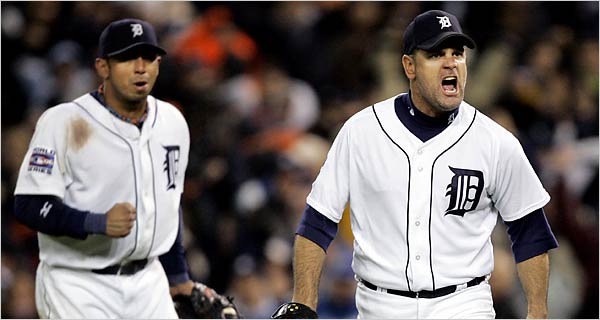 Another explanation could be that Rogers was rubbing first baseman Carlos Guillen’s jersey whenever the latter visited the mound to calm the fiery left-hander down. Note Guillen's right shoulder. Note, too, that whatever Guillen was telling Rogers during those visits did not appear to have much of a soothing effect.
 * * * * * * * *
One more comment about Scott Rolen…at least for now. Rolen was often portrayed in the local media as an introspective fellow with intellectual inclinations. I, on the other hand, always found him rather ordinary when it came to language and logic.
In today’s Inquirer, there is a piece headlined “Rolen Unburdens himself in Game 1” in which the Cardinals’ third baseman presumably gets a load off his allegedly fertile mind. I, for one, have re-read it three or four times and still cannot really figure out what he is saying and which part is the unburdening. Consecutive translations are welcome in the Comments section below. Here is the entire piece:
Scott Rolen's home run in St. Louis' 7-2 victory in Game 1 of the World Series on Saturday night lifted a career 0-for-the-Fall-Classic weight from the former Phillies third baseman.
"We're human beings; I know I didn't get a hit in the last World Series," said Rolen, who was hitless in 15 at-bats for the Cardinals against the Boston Red Sox in 2004.
"No excuses, for whatever reason, it doesn't matter," said Rolen, who went 2 for 4 with a double and an RBI Saturday. "But I also don't want to be shallow to the point to think that last postseason or last World Series has anything to do with what's happening tonight. It's a completely different series."
He had been hitting just .188 with no RBIs this postseason.
Sunday, October 22, 2006
An Article Well Worth Reading
Commenter tc posted this link the other day and it is a fascinating article on baseball’s bias toward power-hitting and its implications. The article, by Michael Lewis (Moneyball) is from the NY Times magazine archives and should be available to readers even without a Times Select account. Give it a try; you will be rewarded. Thanks, tc.
Absolutely, Power Corrupts
Absolutely, Power Corrupts
Friday, October 20, 2006
Ancient Rivals
1934
The Gashouse Gang. Goose Goslin. Joe Medwick. Dizzy Dean. School Boy Rowe. Pepper Martin. Charlie Gehringer. Hank Greenberg.
1968
Bob Gibson. Al Kaline. Denny McClain. Micky Lolich. Lou Brock.
Tradition, or what’s left of it in baseball, prevails this October as ancient rivals Detroit and St. Louis meet in the World Series for the third time in history and the first since 1968. A lot of storied names played in those previous series and while the current rosters would seem to boast fewer memorable players, their meeting does stir memories of the dramatic seven game set that took place nearly forty years ago.
It warms my heart to know this year’s participants will not include such questionable ownership to say nothing of baseball towns as Miami and Phoenix. What it does include are two veteran managers, one admirable (Leyland) and the other not, two players who were traded for each other (Scott Rolen and Placido Polanco), a few aging veterans for whom this may be the last go-round (Jim Edmonds, Kenny Rogers), a passel of young pitching studs (virtually half of the Detroit staff), and the best hitter in all of baseball (Albert Pujols).
It should be a good series. Baseball could use one.
The Gashouse Gang. Goose Goslin. Joe Medwick. Dizzy Dean. School Boy Rowe. Pepper Martin. Charlie Gehringer. Hank Greenberg.
1968
Bob Gibson. Al Kaline. Denny McClain. Micky Lolich. Lou Brock.
Tradition, or what’s left of it in baseball, prevails this October as ancient rivals Detroit and St. Louis meet in the World Series for the third time in history and the first since 1968. A lot of storied names played in those previous series and while the current rosters would seem to boast fewer memorable players, their meeting does stir memories of the dramatic seven game set that took place nearly forty years ago.
It warms my heart to know this year’s participants will not include such questionable ownership to say nothing of baseball towns as Miami and Phoenix. What it does include are two veteran managers, one admirable (Leyland) and the other not, two players who were traded for each other (Scott Rolen and Placido Polanco), a few aging veterans for whom this may be the last go-round (Jim Edmonds, Kenny Rogers), a passel of young pitching studs (virtually half of the Detroit staff), and the best hitter in all of baseball (Albert Pujols).
It should be a good series. Baseball could use one.
Thursday, October 19, 2006
Players
There is a strong tendency in Philadelphia to sit and wonder just what would it be like to be a “player” in the free agent sweepstakes. The Yankees, Mets, Red Sox, Dodgers, these are “players.” Even some of the other Southern California clubs with their enticing weather are “players.”
The Phillies? They are perennial pretenders with the lone exception of five years ago when they signed the most coveted free agent at the time, Jim Thome, who was a Rust Belt kind of guy who wasn’t put off by a blue collar town like Philadelphia. Heck, after Cleveland this place must have looked damn good to him. So, too, did the $86 million offer he received. And let’s face it, though Jim isn’t exactly a rocket scientist he’s the one still laughing all the way to the bank, which includes drafts undoubtedly drawn by the Phillies, who are still paying part of his salary even though he now plays in Chicago.
These days, when a premier free agent comes on the market, local fans can drool over the prospect of his playing here, but in our hearts we know the chances of his signing with the Phils are slim. The Ryan Franklins of baseball will be more than interested, but the marquee players won’t even give the Phillies a second look. Barry Zito? Think left field fence! Alfonso Soriano? I’ve got a bridge for you. Juan Pierre at the top of the batting order? Where’s the beef? Daisuke Matsuzaka? Not in your dreams!
Part of the problem is the perception the Phillies never quite get their act together as an organization. Constantly finishing out of the money will do that. Another issue, at least for pitchers, is the ballpark, which despite playing a little deeper in left field now is still seen, fairly or not, as far too hitter friendly. Still another negative is money. Until this season the Phils haven’t had a lot to spend given the number of long-term contracts to which they were committed. And even when they received a bump in revenues during the inaugural season of their new ballpark, a mere one year later they played in front of 600,000 fewer fans resulting in, you guessed it, much less revenue. One last piece of the puzzle may simply be the Phils don’t ever seem to have players on their roster who can persuade prospective free agents to come here. When is the last time you read of a Phillie lobbying for a free agent to sign here?
So, what’s a team to do when it has many problems to solve and even some money to spend, having shed some of those big contracts, but cannot make the first cut with the premier free agents? There are two possibilities: trade for established talent and/or start stacking up on prospects. GM Pat Gillick may have angered more than a few fans at the July trade deadline when he all but announced he was throwing in the towel for 2006 and 2007, but unless he can pull off some major surprises, he’d be much better off trying to build through trades.
Gillick’s problem at the bargaining table is that he doesn’t have much to offer other teams. Pat Burrell’s name is being bandied about on the Phils own website for god’s sake. If your own club hangs out a big “Price Reduced” sign and makes it clear it considers you damaged goods, how much value can you bring? Brett Myers would interest every club in baseball despite his personality flaws, but that list includes the one for which he currently pitches. The Phils cannot afford to give up a frontline pitcher when they only have two reliable ones – Myers and Cole Hamels - with long-term futures.
As for other pitchers who could be available, there is fallen phenom Gavin Floyd, who rates no higher than a throw-in any longer following his latest outings in the Arizona Fall League, where rookies, has-beens and never-weres are pounding him. Eude Brito isn’t even one of the Phillies top pitching prospects. Ryan Madson faltered as both a starter and reliever and wouldn’t bring a high level prospect in return if the Phils decided to give up on him. The bet here is they are sticking with Madson for one more season anyway since the bullpen is such a mess. Lastly, there aren’t enough pitching prospects down on the farm to bring better or equal value.
The Phils have a few young outfielders and infielders on the 40-man roster but none of them is likely to fetch much either. In fact, the Phils may need Michael Bourn or Chris Roberson when David Dellucci signs elsewhere, they finally trade Burrell and if Gillick deals the one Phillie in whom his own former team has expressed interest: Aaron Rowand. If Rowand can be packaged with a pitcher or two, the White Sox may be tempted to deal Joe Crede. The Sox need a centerfielder and regret the day they traded Rowand. For their part, the Phillies need a third baseman with a good glove and power who could solve a number of their most pressing needs. Crede, who doesn’t strike out often, could bat behind Ryan Howard in the lineup, play a Gold Glove quality third base, and hit for power. At 28 years of age, he would also fit nicely in the Phils’ twenty-something infield.
Crede may not be a marquee player in many peoples’ eyes, but he is the best one out there the Phillies could realistically pursue and land. He may also be the only one who’d come to Philadelphia.
The Phillies? They are perennial pretenders with the lone exception of five years ago when they signed the most coveted free agent at the time, Jim Thome, who was a Rust Belt kind of guy who wasn’t put off by a blue collar town like Philadelphia. Heck, after Cleveland this place must have looked damn good to him. So, too, did the $86 million offer he received. And let’s face it, though Jim isn’t exactly a rocket scientist he’s the one still laughing all the way to the bank, which includes drafts undoubtedly drawn by the Phillies, who are still paying part of his salary even though he now plays in Chicago.
These days, when a premier free agent comes on the market, local fans can drool over the prospect of his playing here, but in our hearts we know the chances of his signing with the Phils are slim. The Ryan Franklins of baseball will be more than interested, but the marquee players won’t even give the Phillies a second look. Barry Zito? Think left field fence! Alfonso Soriano? I’ve got a bridge for you. Juan Pierre at the top of the batting order? Where’s the beef? Daisuke Matsuzaka? Not in your dreams!
Part of the problem is the perception the Phillies never quite get their act together as an organization. Constantly finishing out of the money will do that. Another issue, at least for pitchers, is the ballpark, which despite playing a little deeper in left field now is still seen, fairly or not, as far too hitter friendly. Still another negative is money. Until this season the Phils haven’t had a lot to spend given the number of long-term contracts to which they were committed. And even when they received a bump in revenues during the inaugural season of their new ballpark, a mere one year later they played in front of 600,000 fewer fans resulting in, you guessed it, much less revenue. One last piece of the puzzle may simply be the Phils don’t ever seem to have players on their roster who can persuade prospective free agents to come here. When is the last time you read of a Phillie lobbying for a free agent to sign here?
So, what’s a team to do when it has many problems to solve and even some money to spend, having shed some of those big contracts, but cannot make the first cut with the premier free agents? There are two possibilities: trade for established talent and/or start stacking up on prospects. GM Pat Gillick may have angered more than a few fans at the July trade deadline when he all but announced he was throwing in the towel for 2006 and 2007, but unless he can pull off some major surprises, he’d be much better off trying to build through trades.
Gillick’s problem at the bargaining table is that he doesn’t have much to offer other teams. Pat Burrell’s name is being bandied about on the Phils own website for god’s sake. If your own club hangs out a big “Price Reduced” sign and makes it clear it considers you damaged goods, how much value can you bring? Brett Myers would interest every club in baseball despite his personality flaws, but that list includes the one for which he currently pitches. The Phils cannot afford to give up a frontline pitcher when they only have two reliable ones – Myers and Cole Hamels - with long-term futures.
As for other pitchers who could be available, there is fallen phenom Gavin Floyd, who rates no higher than a throw-in any longer following his latest outings in the Arizona Fall League, where rookies, has-beens and never-weres are pounding him. Eude Brito isn’t even one of the Phillies top pitching prospects. Ryan Madson faltered as both a starter and reliever and wouldn’t bring a high level prospect in return if the Phils decided to give up on him. The bet here is they are sticking with Madson for one more season anyway since the bullpen is such a mess. Lastly, there aren’t enough pitching prospects down on the farm to bring better or equal value.
The Phils have a few young outfielders and infielders on the 40-man roster but none of them is likely to fetch much either. In fact, the Phils may need Michael Bourn or Chris Roberson when David Dellucci signs elsewhere, they finally trade Burrell and if Gillick deals the one Phillie in whom his own former team has expressed interest: Aaron Rowand. If Rowand can be packaged with a pitcher or two, the White Sox may be tempted to deal Joe Crede. The Sox need a centerfielder and regret the day they traded Rowand. For their part, the Phillies need a third baseman with a good glove and power who could solve a number of their most pressing needs. Crede, who doesn’t strike out often, could bat behind Ryan Howard in the lineup, play a Gold Glove quality third base, and hit for power. At 28 years of age, he would also fit nicely in the Phils’ twenty-something infield.
Crede may not be a marquee player in many peoples’ eyes, but he is the best one out there the Phillies could realistically pursue and land. He may also be the only one who’d come to Philadelphia.
Tuesday, October 17, 2006
The Answer?
Now that the managing staff, er I mean coaching staff, is in place, the next order of business for the Phillies is finding a third baseman, a number five hitter who can protect Ryan Howard and another power hitter if they finally move Pat Burrell.
The most intriguing player out there, one who could solve all of these problems, is Aramis Ramirez . But the word on the Cubs third baseman is not all positive.
The blog Cubbiepalooza noted prior to the 2006 season that Ramirez frequently suffered numerous lower body injuries, missed a lot of games, had a questionable work ethic, and was a mediocre fielder. The author concluded his post by announcing that despite all that, he expected Ramirez to have a “monster” year at the plate, improve his conditioning and appear in more games. The author was on the money.
A suburban Chicago newspaper columninst echoed the negative portions of the preceding assessment after the 2006 season, one in which Ramirez appeared in157 games, batted .291 with 38 homers. 119 rbi’s and an OBP of .352. In his piece Mike Imrem described Ramirez this way:
If Ramirez stays, the Cubs have his 38 home runs and 119 runs batted in. If he goes, they’re rid of a guy who appears lazy and disinterested until a new contract is at stake.
Admittedly, that’s a whole lotta’ baggage for one player to carry, but the Phils should take a chance anyway if Ramirez opts out of his Chicago contract and makes himself available. The prospect of an infield of Ramirez, Rollins, Utley and Howard, all in their late ‘20’s, is too good to pass up.
The whole point might be moot if Ramirez chooses to re-sign with the Cubs. I imagine Pat Gillick has to tread very lightly here to avoid the slightest whiff of tampering, but I hope someone from Philadelphia has Ramirez’ cell phone number if not his ear.
The most intriguing player out there, one who could solve all of these problems, is Aramis Ramirez . But the word on the Cubs third baseman is not all positive.
The blog Cubbiepalooza noted prior to the 2006 season that Ramirez frequently suffered numerous lower body injuries, missed a lot of games, had a questionable work ethic, and was a mediocre fielder. The author concluded his post by announcing that despite all that, he expected Ramirez to have a “monster” year at the plate, improve his conditioning and appear in more games. The author was on the money.
A suburban Chicago newspaper columninst echoed the negative portions of the preceding assessment after the 2006 season, one in which Ramirez appeared in157 games, batted .291 with 38 homers. 119 rbi’s and an OBP of .352. In his piece Mike Imrem described Ramirez this way:
If Ramirez stays, the Cubs have his 38 home runs and 119 runs batted in. If he goes, they’re rid of a guy who appears lazy and disinterested until a new contract is at stake.
Admittedly, that’s a whole lotta’ baggage for one player to carry, but the Phils should take a chance anyway if Ramirez opts out of his Chicago contract and makes himself available. The prospect of an infield of Ramirez, Rollins, Utley and Howard, all in their late ‘20’s, is too good to pass up.
The whole point might be moot if Ramirez chooses to re-sign with the Cubs. I imagine Pat Gillick has to tread very lightly here to avoid the slightest whiff of tampering, but I hope someone from Philadelphia has Ramirez’ cell phone number if not his ear.
Monday, October 16, 2006
Three Wise Men
The Phillies announced the hiring of former managers Art Howe, Davey Lopes and Jimmy Williams to fill the vacant coaching spots at third, first and the bench respectively. As Chris Wheeler is bound to say next April, the Phils’ coaching staff now boasts something on the order of 836 years of major league experience. For his part, top man Charlie Manuel has to be looking over his shoulder wondering which of these three ex-skippers listed “interim” on his resume among his capabilities.
I am reminded of Roger Angell’s line that one requirement for becoming a major league manager is to have failed at that post somewhere else. With the edition of not one but three former managers, there will be no shortage of in-house candidates should the occasion arise.
No matter what becomes of the newcomers or incumbent, the Phils signaled earlier this month that they were looking for a few good wise old hands to teach their young studs a thing or two about fundamentals. The threesome who joined the staff today certainly bring experience to the table. Whether or not they have the communication skills needed to get through to an i-Pod toting group of millionaires is another matter.
I am reminded of Roger Angell’s line that one requirement for becoming a major league manager is to have failed at that post somewhere else. With the edition of not one but three former managers, there will be no shortage of in-house candidates should the occasion arise.
No matter what becomes of the newcomers or incumbent, the Phils signaled earlier this month that they were looking for a few good wise old hands to teach their young studs a thing or two about fundamentals. The threesome who joined the staff today certainly bring experience to the table. Whether or not they have the communication skills needed to get through to an i-Pod toting group of millionaires is another matter.
Wither [Sic] The Fan?
Has the post-season in baseball become as irrelevant as the All-Star Game to most fans?
Booming regular season attendance, obscene television revenues and the advent of the World Baseball Classic notwithstanding, fewer people than ever are watching the baseball playoffs. There is little reason to believe those same people will suddenly find religion when the World Series gets underway.
Numerous factors have contributed to this collective big yawn. A longer regular season started the trend as baseball encroached further on territory usually reserved for Fall and Winter sports. For the history buffs out there, the key dates in this discussion are 1958 and 1961. In the former, the Baltimore Colts met the New York Giants in the dramatic sudden-death NFL title game credited with establishing football as the predominant game on the American sporting landscape. Three years later, baseball expanded its regular season from 154 to 162 games and introduced the asterisk as the single most important punctuation mark in its history.
The subsequent advent of the Wild Card and longer playoff series further contributed to the erosion of late-season baseball tolerance. Expansion of the football season to 16 games and the concomitant earlier start to its season and pre-season and the expansion of professional basketball and hockey also cut into baseball’s hegemony. Add in the earlier start to and expansion of the college football season and you have a lot of competition for the average sports fan’s attention at the juncture when baseball is just gearing up for its showcases: the playoffs and post-season.
Few if any other moves have eroded interest in October baseball more than the introduction of interleague play. If nothing else, the curiosity factor about the “other” league was erased when teams from the NL and AL routinely met during the regular season. Few interleague rivalries generate considerable fan interest and local bragging rights (Yankees vs. Mets, Cubs vs. White Sox are exceptions) and most are no more interesting than your regularly scheduled programming. Saturday afternoon, Monday and Thursday night national broadcasts combined with the availability of all games on mlb.com and satellite and the full 162 game presentation by most local stations also means over-exposure. All baseball all the time is, frankly, a whole lot more than all football all the time when you have 30 teams playing 162 games each as opposed to 30 teams playing 16 games each.
The All-Star game used to be the one moment in the middle of the summer when fans could watch the great players from the “other” league go head-to-head. The actual game has been watered down by the pre-game festivities including the home run contest, broadcast in prime time the night before, which probably draws more viewers than the game itself. The All-Star break used to be a three-day interlude, two for travel and one for the contest. Now, it is crammed with pre-game hype and hoopla and doesn’t feel like a break at all. Free agency has also contributed to the watering down of the product considering how many stars change leagues as well as teams multiple times throughout their careers. For better or worse, in the old days Ted Williams and Willie Mays were always going to represent the American and National Leagues respectively and the All-Star game was going to be a real dogfight for bragging rights. Bud Selig has tried to rejuvenate the contest by awarding home field advantage for the World Series to the winning league, a terrible idea that penalizes the visiting team in the Series for the sins of their league.
Baseball executives would be loath to admit it except in private, but most of them would prefer to see teams from the big television markets meeting in the playoffs. Their worst nightmare would be to have teams from the smaller markets meeting throughout the month of October. An early exit by either New York team is considered a disaster; a World Series between, say, the Florida Marlins and Cleveland Indians would be an even bigger one.
The rejuvenation of a Kenny Rogers, emergence of Jose Reyes, and continued brilliance of Albert Pujols is not enough to draw fans back to their television sets for any protracted length of time. And as noted in an earlier post, neither are the exhortations of Tommy LaSorda in some pretty clever ads aimed directly at those deserters. A lot of true fans of the game are staying away in droves and baseball’s alleged brain trust seems clueless how to bring them back. It could get a lot worse before it gets better. Conceivably, it might never get better.
Booming regular season attendance, obscene television revenues and the advent of the World Baseball Classic notwithstanding, fewer people than ever are watching the baseball playoffs. There is little reason to believe those same people will suddenly find religion when the World Series gets underway.
Numerous factors have contributed to this collective big yawn. A longer regular season started the trend as baseball encroached further on territory usually reserved for Fall and Winter sports. For the history buffs out there, the key dates in this discussion are 1958 and 1961. In the former, the Baltimore Colts met the New York Giants in the dramatic sudden-death NFL title game credited with establishing football as the predominant game on the American sporting landscape. Three years later, baseball expanded its regular season from 154 to 162 games and introduced the asterisk as the single most important punctuation mark in its history.
The subsequent advent of the Wild Card and longer playoff series further contributed to the erosion of late-season baseball tolerance. Expansion of the football season to 16 games and the concomitant earlier start to its season and pre-season and the expansion of professional basketball and hockey also cut into baseball’s hegemony. Add in the earlier start to and expansion of the college football season and you have a lot of competition for the average sports fan’s attention at the juncture when baseball is just gearing up for its showcases: the playoffs and post-season.
Few if any other moves have eroded interest in October baseball more than the introduction of interleague play. If nothing else, the curiosity factor about the “other” league was erased when teams from the NL and AL routinely met during the regular season. Few interleague rivalries generate considerable fan interest and local bragging rights (Yankees vs. Mets, Cubs vs. White Sox are exceptions) and most are no more interesting than your regularly scheduled programming. Saturday afternoon, Monday and Thursday night national broadcasts combined with the availability of all games on mlb.com and satellite and the full 162 game presentation by most local stations also means over-exposure. All baseball all the time is, frankly, a whole lot more than all football all the time when you have 30 teams playing 162 games each as opposed to 30 teams playing 16 games each.
The All-Star game used to be the one moment in the middle of the summer when fans could watch the great players from the “other” league go head-to-head. The actual game has been watered down by the pre-game festivities including the home run contest, broadcast in prime time the night before, which probably draws more viewers than the game itself. The All-Star break used to be a three-day interlude, two for travel and one for the contest. Now, it is crammed with pre-game hype and hoopla and doesn’t feel like a break at all. Free agency has also contributed to the watering down of the product considering how many stars change leagues as well as teams multiple times throughout their careers. For better or worse, in the old days Ted Williams and Willie Mays were always going to represent the American and National Leagues respectively and the All-Star game was going to be a real dogfight for bragging rights. Bud Selig has tried to rejuvenate the contest by awarding home field advantage for the World Series to the winning league, a terrible idea that penalizes the visiting team in the Series for the sins of their league.
Baseball executives would be loath to admit it except in private, but most of them would prefer to see teams from the big television markets meeting in the playoffs. Their worst nightmare would be to have teams from the smaller markets meeting throughout the month of October. An early exit by either New York team is considered a disaster; a World Series between, say, the Florida Marlins and Cleveland Indians would be an even bigger one.
The rejuvenation of a Kenny Rogers, emergence of Jose Reyes, and continued brilliance of Albert Pujols is not enough to draw fans back to their television sets for any protracted length of time. And as noted in an earlier post, neither are the exhortations of Tommy LaSorda in some pretty clever ads aimed directly at those deserters. A lot of true fans of the game are staying away in droves and baseball’s alleged brain trust seems clueless how to bring them back. It could get a lot worse before it gets better. Conceivably, it might never get better.
Sunday, October 15, 2006
Rolen Redux
Lately, the atmospheric conditions in Baseball Paradise appear to resemble the weather normally found in more northerly climates with reports that the relationship between Cardinals’ manager Tony La Russa and third baseman Scott Rolen has become quite frosty. One of our favorite columnists, Jim Salisbury, wrote this morning that Rolen is extremely unhappy with at least two benchings as he sees it, one in September and the other two nights ago against the Mets, and is barely on speaking terms with his manager. La Russa, for his part, could care less what Rolen wants or thinks; he’s got his own issues to resolve and job to save. Meanwhile, Salisbury, an even-tempered, considerate guy if ever there was one, gets this year’s post-season award for chutzpah for even asking the questions of Rolen in the first place.
When Salisbury tried to inquire of the former Phillies third baseman whether or not he would entertain a return to the city where he got his professional start, he got a series of cold stares, monosyllabic replies and, no doubt, lifted eyebrows from Rolen. Jim went on to describe Rolen as always “high maintenance,” an understatement of the first water.
Readers of this space are familiar with my take on Rolen. When he forced a trade and left town a few years ago, everyone blamed Larry Bowa and Dallas Green for driving him away. At the time, I wrote:
It’s time to set the record straighter on that subject once and for all. Certainly this observer has been guilty of laying too much of the blame for Rolen’s departure on Larry Bowa.
For nearly two years prior to his trade to St. Louis, Scott Rolen complained early and often in no particular order about the playing surface at the Vet, a lack of commitment to winning and about senior management. He wasn’t necessarily wrong to point out any of these deficiencies (and had lots of company in each instance) but he was more or less a Curt Schilling-in-training, i.e. a major league complainer, with the exception that more often than not he forced people to guess what he was thinking rather than scurry to write down every quote (the more outrageous the merrier) that rolled off his tongue.
Scott Rolen seemed to know better than anyone else what the team needed and what it was unwilling to do to achieve those goals. But his way of communicating his displeasure was to say at every turn, "Do what I want on my schedule." He refused to negotiate a new contract in spring training. Fine. But then he insisted there would be no negotiations during the season. What was the matter, Scott, couldn't you play and make millions at the same time? Next he complained there were no new starting pitchers of the caliber he demanded. Next, he wasn’t going to wait for a new playing surface until 2004.
Nothing was really going to satisfy Scott. And then, of course, there were Larry Bowa and Dallas Green, who openly questioned Scott’s commitment. Say what you will about them, they provided Rolen with the one public explanation for his dissatisfaction. And frankly, I don't blame him for disliking either guy. They aren’t likeable.
Rolen also thought of himself as a deep thinker among men playing boys' games. But it takes more than reading the Jack Kerouac novels he was spotted carrying to qualify. Rolen could have used a few years of college to work on his logic. Precious little of what he said held up to scrutiny only proving that what really mattered was how he felt. And how he felt, denials notwithstanding, was that Bowa and Green accused him of letting down the side and the fans got all over him, too. He just didn’t like playing in Philadelphia.
It would be difficult to extract one item from his soliloquies on the state of baseball in Philadelphia as being paramount (in his mind), but I have settled on the following:
Scott wanted guarantees in a business where there are none. And above all, he wanted a guarantee the Phillies would commit to winning. He pointed to Bobby Abreu, Mike Lieberthal, Doug Glanville and Pat Burrell and wondered aloud (twice), would the Phillies commit to winning by signing them to long contracts? (Three eventually were signed.) Would these players -- the nucleus of the team Rolen envisioned -- be in Philadelphia in the future? And then Rolen announced in the next breath, he wouldn't be here. He was the first one of this so-called nucleus of young stars to be approached about a long-term commitment and he responded by not signing a contract reportedly worth nearly three times the team's then-current payroll.
Scott Rolen can catch a baseball extremely well, hit a baseball well in spurts and run the bases well. Off the field he was no particular credit to his breed and he certainly wasn't the exemplary citizen or Hamlet-like prince many made him out to be. Indeed, he kept to himself, apparently gave relatively little of himself outside the lines and was, by most accounts, a decent guy. True, in this era even a decent guy looks very good, but decency is not a precondition for sainthood. And giving one's all on the field is not unique to Scott Rolen. I can point to several teammates on the Phillies who gave it their all; they just didn't grimace as much as Rolen and wear the same game face. Appearances were not everything.
What Scott Rolen lacked was a thick skin. If you don’t have one, Philadelphia is not your venue. St; Louis is clearly much more to his liking. Had Rolen had a thicker skin he might have been able to weather the storm, especially the one blowing in from the manager’s office. In the end Rolen lacked commitment to Philadelphia and it was on this point that I found local tributes to him following his departure more than ironic. Rolen gave up on the Phillies when they were making a pretty good effort to build a contender. J.D. Drew's refusal to sign here (or was it Scott Boras' refusal?), Curt Schilling's demand to go elsewhere and then Rolen's departure certainly weakened a team that was doing its homework. But malcontents wear out their welcomes sooner or later anyway. Rolen wore his out sooner.
Rolen’s dispute with La Russa would involve a standoff between two guys who believe they have all the answers, at least in their own minds. Neither one is likely to budge, which probably means one will have to go. If the Cardinals fail to make it to the World Series, La Russa is my nominee for a one-way ticket out of town. If they make it to the Series and implode like they did against the Red Sox in 2004, the same travel plans remain in force. If, however, La Russa finally makes it over the hump (and, as an aside I sincerely hope he does not), then Scottie may be looking for a new place to scowl come next season.
Either way, they deserve each other for now.
As for all those fans and writers who lament the day Rolen departed Philadelphia, get over it. He was never meant for this town. The only question now is, was he ever meant for any other one?
When Salisbury tried to inquire of the former Phillies third baseman whether or not he would entertain a return to the city where he got his professional start, he got a series of cold stares, monosyllabic replies and, no doubt, lifted eyebrows from Rolen. Jim went on to describe Rolen as always “high maintenance,” an understatement of the first water.
Readers of this space are familiar with my take on Rolen. When he forced a trade and left town a few years ago, everyone blamed Larry Bowa and Dallas Green for driving him away. At the time, I wrote:
It’s time to set the record straighter on that subject once and for all. Certainly this observer has been guilty of laying too much of the blame for Rolen’s departure on Larry Bowa.
For nearly two years prior to his trade to St. Louis, Scott Rolen complained early and often in no particular order about the playing surface at the Vet, a lack of commitment to winning and about senior management. He wasn’t necessarily wrong to point out any of these deficiencies (and had lots of company in each instance) but he was more or less a Curt Schilling-in-training, i.e. a major league complainer, with the exception that more often than not he forced people to guess what he was thinking rather than scurry to write down every quote (the more outrageous the merrier) that rolled off his tongue.
Scott Rolen seemed to know better than anyone else what the team needed and what it was unwilling to do to achieve those goals. But his way of communicating his displeasure was to say at every turn, "Do what I want on my schedule." He refused to negotiate a new contract in spring training. Fine. But then he insisted there would be no negotiations during the season. What was the matter, Scott, couldn't you play and make millions at the same time? Next he complained there were no new starting pitchers of the caliber he demanded. Next, he wasn’t going to wait for a new playing surface until 2004.
Nothing was really going to satisfy Scott. And then, of course, there were Larry Bowa and Dallas Green, who openly questioned Scott’s commitment. Say what you will about them, they provided Rolen with the one public explanation for his dissatisfaction. And frankly, I don't blame him for disliking either guy. They aren’t likeable.
Rolen also thought of himself as a deep thinker among men playing boys' games. But it takes more than reading the Jack Kerouac novels he was spotted carrying to qualify. Rolen could have used a few years of college to work on his logic. Precious little of what he said held up to scrutiny only proving that what really mattered was how he felt. And how he felt, denials notwithstanding, was that Bowa and Green accused him of letting down the side and the fans got all over him, too. He just didn’t like playing in Philadelphia.
It would be difficult to extract one item from his soliloquies on the state of baseball in Philadelphia as being paramount (in his mind), but I have settled on the following:
Scott wanted guarantees in a business where there are none. And above all, he wanted a guarantee the Phillies would commit to winning. He pointed to Bobby Abreu, Mike Lieberthal, Doug Glanville and Pat Burrell and wondered aloud (twice), would the Phillies commit to winning by signing them to long contracts? (Three eventually were signed.) Would these players -- the nucleus of the team Rolen envisioned -- be in Philadelphia in the future? And then Rolen announced in the next breath, he wouldn't be here. He was the first one of this so-called nucleus of young stars to be approached about a long-term commitment and he responded by not signing a contract reportedly worth nearly three times the team's then-current payroll.
Scott Rolen can catch a baseball extremely well, hit a baseball well in spurts and run the bases well. Off the field he was no particular credit to his breed and he certainly wasn't the exemplary citizen or Hamlet-like prince many made him out to be. Indeed, he kept to himself, apparently gave relatively little of himself outside the lines and was, by most accounts, a decent guy. True, in this era even a decent guy looks very good, but decency is not a precondition for sainthood. And giving one's all on the field is not unique to Scott Rolen. I can point to several teammates on the Phillies who gave it their all; they just didn't grimace as much as Rolen and wear the same game face. Appearances were not everything.
What Scott Rolen lacked was a thick skin. If you don’t have one, Philadelphia is not your venue. St; Louis is clearly much more to his liking. Had Rolen had a thicker skin he might have been able to weather the storm, especially the one blowing in from the manager’s office. In the end Rolen lacked commitment to Philadelphia and it was on this point that I found local tributes to him following his departure more than ironic. Rolen gave up on the Phillies when they were making a pretty good effort to build a contender. J.D. Drew's refusal to sign here (or was it Scott Boras' refusal?), Curt Schilling's demand to go elsewhere and then Rolen's departure certainly weakened a team that was doing its homework. But malcontents wear out their welcomes sooner or later anyway. Rolen wore his out sooner.
Rolen’s dispute with La Russa would involve a standoff between two guys who believe they have all the answers, at least in their own minds. Neither one is likely to budge, which probably means one will have to go. If the Cardinals fail to make it to the World Series, La Russa is my nominee for a one-way ticket out of town. If they make it to the Series and implode like they did against the Red Sox in 2004, the same travel plans remain in force. If, however, La Russa finally makes it over the hump (and, as an aside I sincerely hope he does not), then Scottie may be looking for a new place to scowl come next season.
Either way, they deserve each other for now.
As for all those fans and writers who lament the day Rolen departed Philadelphia, get over it. He was never meant for this town. The only question now is, was he ever meant for any other one?
Saturday, October 14, 2006
Is That For Or Against?
Unless the Phillies are in the playoffs, and before them the Orioles, much of my post-season rooting is of the “against” rather than “for” nature, as in “I don’t care who wins but I sure don’t want (fill in the player or team) ______ to win” or “The city of Detroit could use some good news and, anyway, I don’t like the A’s”.
So, without further ado, let’s see how some of my least favorite people are doing lately.
Ah, there’s Tony La Russa over there in the corner, wearing dark glasses at 12PM EDT. Tony’s chewing out the media…again…for giving his star player Albert Pujols a hard time over the latter’s statement that Tom Glavine, winner of the first game of the series, “wasn’t very good.” Seems Tony thinks the media boys took that one out of context and consequently is threatening to make King Albert’s locker off limits going forward. Tony’s always bitter about something. I’m rooting against him this season as usual, but I have to admit, just once I’d love to see how he would act if he actually won something. Naaaahhhhh.
Speaking of old sour puss, who’s that glum looking dude in the warm-up jacket hanging over the Cards’ dugout railing? Why, it’s our old buddy Scott Rolen. Why isn’t he starting tonight? Seems his manager didn’t like the way he was swinging the bat, even though Scott said his ailing shoulder is fine. What La Russa probably meant is that he has never liked the way Scott swings when the season is on the line. He’s something like 1 for his entire career in the post-season. OK, that might be a slight exaggeration, but don’t tell that to Tony.
Hey, is that the old alpaca-breeder himself running in to the mound at Shea Stadium in the bottom of the ninth with the game knotted at 6? Darned if it isn’t. Well, you gotta’ hand it to Billy, he said he wanted to play for a winner instead of those perennial losers in Philadelphia and here he is, on the national stage and with the game on the line. Oops! Did Billy just throw a home run ball to a guy with exactly two round-trippers to his credit in 316 at bats this season? Sure enough. Wait. Billy isn’t finished. Here come two more runs across the plate. Good thing his old buddy Craig Biggio isn’t due up next.
Speaking of pitchers with less than stellar post-season credentials up to now, how ‘bout that 42-year old hot head in Detroit, eh?! And Rogers hasn’t even taken a swing at a cameraman. Just goes to show how even-tempered a guy can be when he’s on a winning team.
Finally, old pal Todd Jones got his second save of the post-season for the Tigers in yesterday’s game.. Mind you, as previously noted, I want Detroit to win it all, not just the AL pennant, but I wouldn’t mind if Jones stumbled along the way. You may recall Mr. Jones had a few less than flattering things to say about Philadelphia upon his departure last year. Never mind that he absolutely stunk up the place during his brief tenure in the City of Brotherly Love; Mr. Jones thought it was the worst place he’d ever played in…or hung a breaking ball for that matter...bar none. In fact, he thought so little of our little metropolis that he was still talking about it a year later in his very own blog. I wonder if we’ll get a mention in the locker room celebration if the Tigers win? Jonesy doesn’t strike me as the kind of guy who lets things go easily.
So, without further ado, let’s see how some of my least favorite people are doing lately.
Ah, there’s Tony La Russa over there in the corner, wearing dark glasses at 12PM EDT. Tony’s chewing out the media…again…for giving his star player Albert Pujols a hard time over the latter’s statement that Tom Glavine, winner of the first game of the series, “wasn’t very good.” Seems Tony thinks the media boys took that one out of context and consequently is threatening to make King Albert’s locker off limits going forward. Tony’s always bitter about something. I’m rooting against him this season as usual, but I have to admit, just once I’d love to see how he would act if he actually won something. Naaaahhhhh.
Speaking of old sour puss, who’s that glum looking dude in the warm-up jacket hanging over the Cards’ dugout railing? Why, it’s our old buddy Scott Rolen. Why isn’t he starting tonight? Seems his manager didn’t like the way he was swinging the bat, even though Scott said his ailing shoulder is fine. What La Russa probably meant is that he has never liked the way Scott swings when the season is on the line. He’s something like 1 for his entire career in the post-season. OK, that might be a slight exaggeration, but don’t tell that to Tony.
Hey, is that the old alpaca-breeder himself running in to the mound at Shea Stadium in the bottom of the ninth with the game knotted at 6? Darned if it isn’t. Well, you gotta’ hand it to Billy, he said he wanted to play for a winner instead of those perennial losers in Philadelphia and here he is, on the national stage and with the game on the line. Oops! Did Billy just throw a home run ball to a guy with exactly two round-trippers to his credit in 316 at bats this season? Sure enough. Wait. Billy isn’t finished. Here come two more runs across the plate. Good thing his old buddy Craig Biggio isn’t due up next.
Speaking of pitchers with less than stellar post-season credentials up to now, how ‘bout that 42-year old hot head in Detroit, eh?! And Rogers hasn’t even taken a swing at a cameraman. Just goes to show how even-tempered a guy can be when he’s on a winning team.
Finally, old pal Todd Jones got his second save of the post-season for the Tigers in yesterday’s game.. Mind you, as previously noted, I want Detroit to win it all, not just the AL pennant, but I wouldn’t mind if Jones stumbled along the way. You may recall Mr. Jones had a few less than flattering things to say about Philadelphia upon his departure last year. Never mind that he absolutely stunk up the place during his brief tenure in the City of Brotherly Love; Mr. Jones thought it was the worst place he’d ever played in…or hung a breaking ball for that matter...bar none. In fact, he thought so little of our little metropolis that he was still talking about it a year later in his very own blog. I wonder if we’ll get a mention in the locker room celebration if the Tigers win? Jonesy doesn’t strike me as the kind of guy who lets things go easily.
Friday, October 13, 2006
The Playoffs
The New York Mets sent the eldest statesman on either roster out to pitch last night but it was the St. Louis Cardinals who looked old when all was said and done.
Forty year old Tom Glavine shut down the Cardinals on four hits over seven innings as the Mets took a 1-0 lead in the NLCS with their 2-0 win last night. Carlos Beltran, who always seems to step up in the post-season, accounted for both runs with a tremendous home run in the sixth inning.
The Cardinals hit the ball hard with men on base a few times last night, but always right at someone. Still, the game may have been a preview of the dying throes of a Cardinals team that has been to the post-season several years in a row with largely the same cast of characters only to fall short each time. Jim Edmonds is probably in his last season in St. Louis. Scott Rolen continues to be plagued by injuries. Closer Jason Isringhausen was lost before the playoffs began, undergoing hip surgery in mid-September. Only King Albert remains young, vigorous and consistently productive, but even he missed some time during the season with an injury.
St. Louis only had the fifth best record in the National League this season but backed into the Central Division title in the final days despite playing poorly since the All-Star break. They managed to rally themselves against a weak-hitting San Diego team to sweep the first round of the playoffs, but the Mets aren’t the Padres. Despite losing Pedro Martinez and El Duque, New York has the most potent lineup in the league even when Endy Chavez is substituting for Cliff Floyd and St. Louis doesn’t appear to have the pitching to neutralize them.
* * * * * * * * *
Cardinals’ skipper Tony La Russa ordered David Wright intentionally walked in the sixth inning. Normally, that decision would not merit special attention, but prior to the game La Russa said it would be cowardly of the Mets to pitch around Albert Pujols during the series.
I can only assume La Russa was scared, really scared, of Mr. Wright.
* * * * * * * * *
Maybe you can teach an old dog some new tricks. Normally, Bud Selig would wear a plywood suit in a hurricane rather than postpone a playoff game or change its start time, but with the tonight’s forecast in Detroit calling for temperatures to dip into the ‘30’s with strong, gusty winds and possible snow showers, the Commissioner has relented and moved the start time up to 4:30. The forecast for the afternoon calls for a few showers and temperatures in the high 40’s..
Being a mid-westerner, Bud will show up appropriately dressed with long johns and a parka, unlike Bowie Kuhn, who once showed up for a frosty World Series game lightly dressed with only a sports jacket in a clear albeit pathetic attempt to prove to the world watching at home that the weather wasn’t bad at all. The folks at home weren’t fooled, however. Maybe it was the two guys sitting to either side of Kuhn, each of whom was dressed in an outfit that looked like the Michelin Tire mascot.
* * * * * * * * *
Speaking of corporate sponsors, which we weren’t, really, MLB and the networks that televise their games are selling naming rights to everything within earshot if not sight. Maybe the outfield walls don’t look like a European soccer stadium all decked out with logos, yet, but every other aspect of a baseball telecast comes replete with a sponsor. The Exxon-Mobil keys to the game. The WebMD injury report. The Pepsi this and Coke that. Yeah, I know, the business of America is business, but does every other sentence uttered by the clones in the broadcast booth have to come with its own corporate tag?
Forty year old Tom Glavine shut down the Cardinals on four hits over seven innings as the Mets took a 1-0 lead in the NLCS with their 2-0 win last night. Carlos Beltran, who always seems to step up in the post-season, accounted for both runs with a tremendous home run in the sixth inning.
The Cardinals hit the ball hard with men on base a few times last night, but always right at someone. Still, the game may have been a preview of the dying throes of a Cardinals team that has been to the post-season several years in a row with largely the same cast of characters only to fall short each time. Jim Edmonds is probably in his last season in St. Louis. Scott Rolen continues to be plagued by injuries. Closer Jason Isringhausen was lost before the playoffs began, undergoing hip surgery in mid-September. Only King Albert remains young, vigorous and consistently productive, but even he missed some time during the season with an injury.
St. Louis only had the fifth best record in the National League this season but backed into the Central Division title in the final days despite playing poorly since the All-Star break. They managed to rally themselves against a weak-hitting San Diego team to sweep the first round of the playoffs, but the Mets aren’t the Padres. Despite losing Pedro Martinez and El Duque, New York has the most potent lineup in the league even when Endy Chavez is substituting for Cliff Floyd and St. Louis doesn’t appear to have the pitching to neutralize them.
* * * * * * * * *
Cardinals’ skipper Tony La Russa ordered David Wright intentionally walked in the sixth inning. Normally, that decision would not merit special attention, but prior to the game La Russa said it would be cowardly of the Mets to pitch around Albert Pujols during the series.
I can only assume La Russa was scared, really scared, of Mr. Wright.
* * * * * * * * *
Maybe you can teach an old dog some new tricks. Normally, Bud Selig would wear a plywood suit in a hurricane rather than postpone a playoff game or change its start time, but with the tonight’s forecast in Detroit calling for temperatures to dip into the ‘30’s with strong, gusty winds and possible snow showers, the Commissioner has relented and moved the start time up to 4:30. The forecast for the afternoon calls for a few showers and temperatures in the high 40’s..
Being a mid-westerner, Bud will show up appropriately dressed with long johns and a parka, unlike Bowie Kuhn, who once showed up for a frosty World Series game lightly dressed with only a sports jacket in a clear albeit pathetic attempt to prove to the world watching at home that the weather wasn’t bad at all. The folks at home weren’t fooled, however. Maybe it was the two guys sitting to either side of Kuhn, each of whom was dressed in an outfit that looked like the Michelin Tire mascot.
* * * * * * * * *
Speaking of corporate sponsors, which we weren’t, really, MLB and the networks that televise their games are selling naming rights to everything within earshot if not sight. Maybe the outfield walls don’t look like a European soccer stadium all decked out with logos, yet, but every other aspect of a baseball telecast comes replete with a sponsor. The Exxon-Mobil keys to the game. The WebMD injury report. The Pepsi this and Coke that. Yeah, I know, the business of America is business, but does every other sentence uttered by the clones in the broadcast booth have to come with its own corporate tag?
Wednesday, October 11, 2006
Managers
Someone hire Lou Pinella, please, name him manager, and make him report for duty without further delay! The guy is killing me with his colorless commentary. I could only take about three or four minutes of Lou’s unsweetened voice in game one of the ALCS last night before hitting the mute button. I’ll grant Lou knows baseball and I will assume that is the reason the networks who hire these guys for post-season duty don’t ask them to audition, but for god’s sake, shouldn’t there be some requirement about having a voice that isn’t grating?
* * * * * * * *
Speaking of grating, Tony La Russa is in fine form already. The smug manager of the Cardinals, already a genius in his own mind, had this to say on the subject of whether or not the Mets would pitch to Albert Pujols:
"I keep repeating Felipe Alou's quote about this being a competition. You raise competitors, not cowards. I don't think [pitching around Pujols] is the right way to compete."
Raising “cowards”? I’ve never known a manager to cry so much before the fact than La Russa. If he were facing a team with only one reliable hitter in the lineup and with the guy batting behind him favoring a surgically-repaired shoulder, what would Tony do? Challenge him for the good of the game? Set an example for the kids who are watching? Pitch around him? Pick one.
* * * * * * * *
More thoughts on managers today. What in the world was Joe Torre thinking when he re-upped for another year in New York? I assume he doesn’t need the income (though it is never wise to count other peoples’ money). He doesn’t need another ring on his fingers. And he couldn’t possibly need the public second-guessing and carping from his owner. So, what makes Joe run? The guess here is that Joe is motivated by the perception that the Yankees were expected to win it all and haven’t…lately. But as commenter extraordinaire (domestic division) RSB pointed out yesterday, these Yankees are less a team than a collection of All-Stars. I agreed with RSB and likened them to the collection of basketball superstars the United States persists in assembling to represent the country in the Olympics and World championships. Still, though I am the last guy in the universe who could be called a Yankees apologist, New York might have fared better had they not suffered a lot of injuries that persisted into the playoffs. Mike Mussina and Randy Johnson were coming back from various ailments and, frankly, are old and older. Johnson is just the sort of over-the-hill superstar King George likes to acquire. Jason Giambi’s wrist and questionable fielding even when healthy forced Torre to use Gary Sheffield at first base, a major mistake. Sheffield was also just back from the injury list and looked completely overmatched. A-Rod, of course, simply disappeared as did Robinson Cano.
Don’t get me wrong, the Tigers won rather than the Yankees lost, but I remain convinced that the long season wore down those aging veterans more than it did those young cats.
Memo to Joe: your guys aren’t going to be younger next year.
* * * * * * * *
One last word on managers. The Tigers are starting to look like destiny’s team. A good mix of veterans and youngsters, they are making the pitches, getting the clutch hits and catching and throwing the ball well. Their manager has been through the post-season before and appears to have prepared his players, virtually none of whom has played this deep in October before, well. Leyland doesn’t second-guess himself; nor is he unwilling to make unconventional moves. When he yanked Jeremy Bonderman the other day when the kid had a chance to pitch a complete game, was holding a comfortable lead in the top of the ninth inning, and had a 1-1 count on the batter with one out, Leyland was making the kind of decision that sets him apart. Rather than be ticked off, Bonderman agreed with the move.
I am picking the Tigers to go all the way.
* * * * * * * *
Speaking of grating, Tony La Russa is in fine form already. The smug manager of the Cardinals, already a genius in his own mind, had this to say on the subject of whether or not the Mets would pitch to Albert Pujols:
"I keep repeating Felipe Alou's quote about this being a competition. You raise competitors, not cowards. I don't think [pitching around Pujols] is the right way to compete."
Raising “cowards”? I’ve never known a manager to cry so much before the fact than La Russa. If he were facing a team with only one reliable hitter in the lineup and with the guy batting behind him favoring a surgically-repaired shoulder, what would Tony do? Challenge him for the good of the game? Set an example for the kids who are watching? Pitch around him? Pick one.
* * * * * * * *
More thoughts on managers today. What in the world was Joe Torre thinking when he re-upped for another year in New York? I assume he doesn’t need the income (though it is never wise to count other peoples’ money). He doesn’t need another ring on his fingers. And he couldn’t possibly need the public second-guessing and carping from his owner. So, what makes Joe run? The guess here is that Joe is motivated by the perception that the Yankees were expected to win it all and haven’t…lately. But as commenter extraordinaire (domestic division) RSB pointed out yesterday, these Yankees are less a team than a collection of All-Stars. I agreed with RSB and likened them to the collection of basketball superstars the United States persists in assembling to represent the country in the Olympics and World championships. Still, though I am the last guy in the universe who could be called a Yankees apologist, New York might have fared better had they not suffered a lot of injuries that persisted into the playoffs. Mike Mussina and Randy Johnson were coming back from various ailments and, frankly, are old and older. Johnson is just the sort of over-the-hill superstar King George likes to acquire. Jason Giambi’s wrist and questionable fielding even when healthy forced Torre to use Gary Sheffield at first base, a major mistake. Sheffield was also just back from the injury list and looked completely overmatched. A-Rod, of course, simply disappeared as did Robinson Cano.
Don’t get me wrong, the Tigers won rather than the Yankees lost, but I remain convinced that the long season wore down those aging veterans more than it did those young cats.
Memo to Joe: your guys aren’t going to be younger next year.
* * * * * * * *
One last word on managers. The Tigers are starting to look like destiny’s team. A good mix of veterans and youngsters, they are making the pitches, getting the clutch hits and catching and throwing the ball well. Their manager has been through the post-season before and appears to have prepared his players, virtually none of whom has played this deep in October before, well. Leyland doesn’t second-guess himself; nor is he unwilling to make unconventional moves. When he yanked Jeremy Bonderman the other day when the kid had a chance to pitch a complete game, was holding a comfortable lead in the top of the ninth inning, and had a 1-1 count on the batter with one out, Leyland was making the kind of decision that sets him apart. Rather than be ticked off, Bonderman agreed with the move.
I am picking the Tigers to go all the way.
Tuesday, October 10, 2006
Hard Sell
When major league baseball realigned its divisions in the early 1970’s and implemented the wild card several years later, the explanation given was that such changes would increase spectator interest in more cities as the season wound down if more teams were in the hunt for a post-season berth. The unspoken motive behind the decision was to increase television revenues by extending the season generally and, baseball executives hoped, to more large markets.
The Commissioner’s office could barely conceal its glee when teams from New York, Los Angeles and Chicago were in the hunt; conversely, they secretly must have rooted against a post-season filled with the likes of Cleveland, Kansas City or Milwaukee. No need to worry there, Bud; thanks in part to television revenues, small market teams have generally been infrequent visitors to the post-season for quite some time.
The point of all of this preamble is that despite the increased attendance and television ratings in cities such as Philadelphia, San Diego and Minneapolis as the recently-concluded Wild Card chase produced, the benefits of an extended season with more teams participating seems ultimately to have fallen short of MLB’s objectives. At least that is the preliminary conclusion we must draw based on the series of ads running on television starring former Dodgers’ manager Tommy Lasorda.
In them, Lasorda, dressed in black tie, visits the homes of various fans whose teams failed to make the playoffs. Finding them hiding in various places, mourning their home team’s failure to make the playoffs (one is up in a tree, another in a kitchen cabinet), Lasorda doesn’t merely coax them to come out, he exhorts them to get a grip and watch the post-season on television.
Real fans don’t hide in October. They celebrate it!, he admonishes one fan. It’s October. You’re a baseball fan. Watch the games!, he virtually shouts at another, concluding, I live for this! You live for this! The world lives for this! To the TV!
Judging from comments in the phlogosphere, few "real fans" are watching much if any of the current playoffs. And with the Yankees and Dodgers already eliminated, Tommy’s hard sell just got harder.
The Commissioner’s office could barely conceal its glee when teams from New York, Los Angeles and Chicago were in the hunt; conversely, they secretly must have rooted against a post-season filled with the likes of Cleveland, Kansas City or Milwaukee. No need to worry there, Bud; thanks in part to television revenues, small market teams have generally been infrequent visitors to the post-season for quite some time.
The point of all of this preamble is that despite the increased attendance and television ratings in cities such as Philadelphia, San Diego and Minneapolis as the recently-concluded Wild Card chase produced, the benefits of an extended season with more teams participating seems ultimately to have fallen short of MLB’s objectives. At least that is the preliminary conclusion we must draw based on the series of ads running on television starring former Dodgers’ manager Tommy Lasorda.
In them, Lasorda, dressed in black tie, visits the homes of various fans whose teams failed to make the playoffs. Finding them hiding in various places, mourning their home team’s failure to make the playoffs (one is up in a tree, another in a kitchen cabinet), Lasorda doesn’t merely coax them to come out, he exhorts them to get a grip and watch the post-season on television.
Real fans don’t hide in October. They celebrate it!, he admonishes one fan. It’s October. You’re a baseball fan. Watch the games!, he virtually shouts at another, concluding, I live for this! You live for this! The world lives for this! To the TV!
Judging from comments in the phlogosphere, few "real fans" are watching much if any of the current playoffs. And with the Yankees and Dodgers already eliminated, Tommy’s hard sell just got harder.
Monday, October 09, 2006
Bits And Pieces
Buck O’Neil died last week and with his passing baseball lost its final chance to honor him while he was alive to enjoy it by inducting the former Negro Leagues player, chronicler and ambassador into the Hall of Fame. To the voters who withheld their support I can only say, he was characteristically magnanimous in the disappointment at his rejection while it would be hard to imagine how you will explain your self-righteousness going forward.
* * * * * * * *
Good pitching beat good hitting in the Motor City Saturday night. More to the point, good pitching beat no hitting. I cannot recall seeing a lineup of such diverse batting tendencies – free swingers, patient hitters, power hitters, line drive hitters – go collectively cold quite like the Yankees did. Of course we should give credit to the Tigers’ staff, which pitched brilliantly, but the ineptitude of the Yankee lineup, particularly but not solely Alex Rodriguez, was absolute. When a lineup is called Murderers Row and Robinson Cano, you expect a little more production than we saw.
Going into the series the feeling was the Yankees biggest weakness was its own pitching staff and as it turned out they were hardly a match for the Tigers, but a clutch hit here or there might have jump started the Yankees offense and made the series more interesting if not closer. The other aspect of this Yankee club that did them in was there poor fielding. Having to choose between Gary Sheffield and Jason Giambi at first base was only one of Joe Torre’s nightmares for this series; watching Rodriguez at third was a season-long one. If ever someone needed a change of scenery it is Rodriguez.
After the series, the usual reports surfaced immediately that “The Boss” was angry. Any owner would express his disappointment over such a quick exit from the post-season, but not King George. Disappointment is not in his vocabulary. He overpaid his money and expects nothing less than satisfaction, i.e., the World Series championship; anything less means heads must roll. Torre’s is reportedly on the block and after years of a strained relationship between the two, he probably looks forward to leaving the Bronx; for his part, King George is likely to accommodate him.
Does anyone think the Yankees would hesitate to bring back former players Lou Piniella (who also managed them in the late '80's) or Joe Girardi to take over the reigns? Steinbrenner has shown a tendency to prefer “family” but it is difficult to imagine how the strong-willed Piniella or the apparently equally self-assured Girardi would tolerate any interference from on high. Of course Piniella has already managed the Yankees before, so he is clearly familiar with the owner's tendencies, but both of them were a lot younger then and perhaps marginally more tolerant than they are now. As for how Girardi would handle Steinbrenner's participation, that is anyone's guess, but among the latter's many faults, berating the umpires from a field box is not one of them.
In the end, Torre is very popular with most of his players, and they would like to see him stay. King George does not run things based on popularity, however, as his treatement of Yogi Berra and other ex-Yankees over the years clearly demonstrates. (Berra and the Yankees are now reconciled.) The Yankees lost this series for two reasons: they ran into an inspired Tigers team and they got old. Going into the playoffs the Yankees' most experienced starters were either injured or reovering from injuries. Several position players had their share of nicks and bruises, too, and others were in various stages of recovery. It's a long season as nearly everyone will tell you when asked. In the Yankees' case it was apparently just a little too long.
* * * * * * * *
The other team in New York fared far better. Going into their series the feeling was the Mets were in big trouble because of their starting pitching, but unlike their cross-town rivals, they did hit the ball. Their lineup, frankly is more fearsome than that of the Yankees because the mix of speed and power keeps the pressure on with hitters 1 – 8. And unlike King George’s team, the Mets are capable of overcoming any limitations of the starting rotation in a short series by outscoring their opponents. Their bullpen is superior, too, and it showed throughout the series.
The Dodgers’ Jeff Kent commented after the sweep that though it might sound “cheesy” he felt his team outplayed the Mets but the New Yorkers were luckier. It does sound “cheesy”, Jeff.
* * * * * * * *
Old friend Placido Polanco is still playing baseball on this date but former teammates Marlon Anderson and Bobby Abreu are not. In the two games in Detroit, Abreu could be seen wearing a familiar pained expression, one we saw for many years when his pinstripes were red not black. Polanco also grimaced throughout the first round, but that’s his normal expression.
It looks like Endy Chavez, whose career in Philadelphia could charitably be described as modest, will get the start in left field for the Mets after Cliff Floyd strained his Achilles heel. Chavez had a marvelous season as a super-sub in New York. Look for him to have a great series against the Cardinals. Chavez is just the sort of bit player who shines on the national stage.
* * * * * * * *
Good pitching beat good hitting in the Motor City Saturday night. More to the point, good pitching beat no hitting. I cannot recall seeing a lineup of such diverse batting tendencies – free swingers, patient hitters, power hitters, line drive hitters – go collectively cold quite like the Yankees did. Of course we should give credit to the Tigers’ staff, which pitched brilliantly, but the ineptitude of the Yankee lineup, particularly but not solely Alex Rodriguez, was absolute. When a lineup is called Murderers Row and Robinson Cano, you expect a little more production than we saw.
Going into the series the feeling was the Yankees biggest weakness was its own pitching staff and as it turned out they were hardly a match for the Tigers, but a clutch hit here or there might have jump started the Yankees offense and made the series more interesting if not closer. The other aspect of this Yankee club that did them in was there poor fielding. Having to choose between Gary Sheffield and Jason Giambi at first base was only one of Joe Torre’s nightmares for this series; watching Rodriguez at third was a season-long one. If ever someone needed a change of scenery it is Rodriguez.
After the series, the usual reports surfaced immediately that “The Boss” was angry. Any owner would express his disappointment over such a quick exit from the post-season, but not King George. Disappointment is not in his vocabulary. He overpaid his money and expects nothing less than satisfaction, i.e., the World Series championship; anything less means heads must roll. Torre’s is reportedly on the block and after years of a strained relationship between the two, he probably looks forward to leaving the Bronx; for his part, King George is likely to accommodate him.
Does anyone think the Yankees would hesitate to bring back former players Lou Piniella (who also managed them in the late '80's) or Joe Girardi to take over the reigns? Steinbrenner has shown a tendency to prefer “family” but it is difficult to imagine how the strong-willed Piniella or the apparently equally self-assured Girardi would tolerate any interference from on high. Of course Piniella has already managed the Yankees before, so he is clearly familiar with the owner's tendencies, but both of them were a lot younger then and perhaps marginally more tolerant than they are now. As for how Girardi would handle Steinbrenner's participation, that is anyone's guess, but among the latter's many faults, berating the umpires from a field box is not one of them.
In the end, Torre is very popular with most of his players, and they would like to see him stay. King George does not run things based on popularity, however, as his treatement of Yogi Berra and other ex-Yankees over the years clearly demonstrates. (Berra and the Yankees are now reconciled.) The Yankees lost this series for two reasons: they ran into an inspired Tigers team and they got old. Going into the playoffs the Yankees' most experienced starters were either injured or reovering from injuries. Several position players had their share of nicks and bruises, too, and others were in various stages of recovery. It's a long season as nearly everyone will tell you when asked. In the Yankees' case it was apparently just a little too long.
* * * * * * * *
The other team in New York fared far better. Going into their series the feeling was the Mets were in big trouble because of their starting pitching, but unlike their cross-town rivals, they did hit the ball. Their lineup, frankly is more fearsome than that of the Yankees because the mix of speed and power keeps the pressure on with hitters 1 – 8. And unlike King George’s team, the Mets are capable of overcoming any limitations of the starting rotation in a short series by outscoring their opponents. Their bullpen is superior, too, and it showed throughout the series.
The Dodgers’ Jeff Kent commented after the sweep that though it might sound “cheesy” he felt his team outplayed the Mets but the New Yorkers were luckier. It does sound “cheesy”, Jeff.
* * * * * * * *
Old friend Placido Polanco is still playing baseball on this date but former teammates Marlon Anderson and Bobby Abreu are not. In the two games in Detroit, Abreu could be seen wearing a familiar pained expression, one we saw for many years when his pinstripes were red not black. Polanco also grimaced throughout the first round, but that’s his normal expression.
It looks like Endy Chavez, whose career in Philadelphia could charitably be described as modest, will get the start in left field for the Mets after Cliff Floyd strained his Achilles heel. Chavez had a marvelous season as a super-sub in New York. Look for him to have a great series against the Cardinals. Chavez is just the sort of bit player who shines on the national stage.
Thursday, October 05, 2006
Lieberthal Departs...Unceremoniously
With the news that Mike Lieberthal underwent successful abdominal surgery yesterday, his final chapter in Philadelphia is closed. It can be affirmed Mike went out with a whimper, which says more about the Phillies than it does about him. The 34 year old catcher will be a free agent after the season, and there is no chance he will be coming back.
GM Pat Gillick made little effort to hide his feelings about Lieberthal simply stating that the club was going in a different direction that didn’t include him. That is all well and good, but the club might have done something prior to the last game of the season to honor in some way the senior Phillie in terms of service, a catcher who batted .275 over his 13-year career with the team and averaged nearly a hit a game and a run scored every other one. Lieberthal, who set a record for total number of games behind the plate, may also have led the club in surgeries endured.
For that he got one of the all-time unceremonious sendoffs.
GM Pat Gillick made little effort to hide his feelings about Lieberthal simply stating that the club was going in a different direction that didn’t include him. That is all well and good, but the club might have done something prior to the last game of the season to honor in some way the senior Phillie in terms of service, a catcher who batted .275 over his 13-year career with the team and averaged nearly a hit a game and a run scored every other one. Lieberthal, who set a record for total number of games behind the plate, may also have led the club in surgeries endured.
For that he got one of the all-time unceremonious sendoffs.
Not Quite A Miracle
No one in the phlogosphere, dare I say the entire blogosphere, hates the Mets as much as I do. Remember, my younger brethren, I grew up in Baltimore and watched the Miracle Mets beat a far superior Orioles team in the 1969 World Series. Oh, sure, there are those who still argue the Mets won with great pitching, but that’s just part of the story, and the convenient one at that.
They won that series because Al Weis, who hit 7 home runs in 1578 at bats over ten seasons decided to hit one on the big stage. They won because Ron Swoboda, who would never be mistaken for a real outfielder, made a once-in-a-lifetime diving catch on a sinking line drive by Brooks Robinson that would have broken one of the games, a loss, wide open.
You could say, well, that’s water over the damn, but the water is still flowing 37 years later for this fan.
In the end they won because during the post-season strange and wondrous things can and do happen. Take, for instance, yesterday’s game at Shea Stadium.
Despite my grudge, I have to give the Mets credit for an exciting win over the Dodgers. The Mets began the game, indeed the series, without two of its top three pitchers. They were forced to start a rookie in game one though I cannot for the life of me figure out why the rotation had not been set up to start Tom Glavine instead. It’s not as though the Mets had to fight to win their division.
Regardless of who was on the mound, the Mets present one formidable lineup with no real holes. That’s why they won yesterday against a hot Dodgers team that had steamrolled its way into the post-season with one dramatic comeback after another. And they almost pulled off another one yesterday when Nomar Garciaparra knocked in two runs to tie the score in the sixth inning but failed to keep alive another rally against Billy Wagner when he struck out with the Dodgers trailing by a run, a man on second and two outs in the ninth.
Had Dodgers third base coach Rich Donnelly not been doing his best Bill Dancy imitation early in the contest, the Dodgers might have won this game, but he waved around every base runner within earshot if not sight on a bizarre play in which Mets catcher Paul Lo Duca tagged out two runners in rapid succession on a single throw to the plate. As it turned out, Dodgers catcher Russell Martin singled into a double play, an ignominious footnote he’d probably like to forget.
A number of Mets players without post-season experience played like the seasoned veterans only some of them are, no more so than Carlos Delgado, who was the batting hero of the game for New York. The win didn’t exactly qualify as a miracle, even though the play at the plate is likely to go down in legend, but it got the Mets off to good start. Of course, the Orioles took game one in 1969.
They won that series because Al Weis, who hit 7 home runs in 1578 at bats over ten seasons decided to hit one on the big stage. They won because Ron Swoboda, who would never be mistaken for a real outfielder, made a once-in-a-lifetime diving catch on a sinking line drive by Brooks Robinson that would have broken one of the games, a loss, wide open.
You could say, well, that’s water over the damn, but the water is still flowing 37 years later for this fan.
In the end they won because during the post-season strange and wondrous things can and do happen. Take, for instance, yesterday’s game at Shea Stadium.
Despite my grudge, I have to give the Mets credit for an exciting win over the Dodgers. The Mets began the game, indeed the series, without two of its top three pitchers. They were forced to start a rookie in game one though I cannot for the life of me figure out why the rotation had not been set up to start Tom Glavine instead. It’s not as though the Mets had to fight to win their division.
Regardless of who was on the mound, the Mets present one formidable lineup with no real holes. That’s why they won yesterday against a hot Dodgers team that had steamrolled its way into the post-season with one dramatic comeback after another. And they almost pulled off another one yesterday when Nomar Garciaparra knocked in two runs to tie the score in the sixth inning but failed to keep alive another rally against Billy Wagner when he struck out with the Dodgers trailing by a run, a man on second and two outs in the ninth.
Had Dodgers third base coach Rich Donnelly not been doing his best Bill Dancy imitation early in the contest, the Dodgers might have won this game, but he waved around every base runner within earshot if not sight on a bizarre play in which Mets catcher Paul Lo Duca tagged out two runners in rapid succession on a single throw to the plate. As it turned out, Dodgers catcher Russell Martin singled into a double play, an ignominious footnote he’d probably like to forget.
A number of Mets players without post-season experience played like the seasoned veterans only some of them are, no more so than Carlos Delgado, who was the batting hero of the game for New York. The win didn’t exactly qualify as a miracle, even though the play at the plate is likely to go down in legend, but it got the Mets off to good start. Of course, the Orioles took game one in 1969.
Subscribe to:
Posts (Atom)